'No Grid' or 'Grid Lost' Error on Solar Inverters: Complete Troubleshooting Guide
Your inverter says No Grid, Grid Lost or Utility Loss even though the house has power. Here's how to trace the problem from the inverter terminals back to the meter, safely and in the right order.
A No Grid, Grid Lost, Utility Loss, Mains Lost or AC Not Connected message means the inverter cannot detect a valid AC supply at its output terminals. During a genuine power cut this is exactly what should happen — grid-tie inverters must shut down when the grid goes down to protect line workers. This is known as anti-islanding protection.
The puzzle comes when the lights in the house are on but the inverter still insists there is no grid. In that case, the AC supply is being lost somewhere between your distribution board and the inverter. This guide walks you through the checks in the order a technician would do them.
Quick answer
If the house has power but the inverter shows No Grid, the fault is almost always in the AC path to the inverter: a tripped MCB or RCD, a switched-off AC isolator, a loose or burnt terminal, a blown fuse in a solar AC distribution box, or — on three-phase inverters — a missing phase or neutral. Check each device in the path in sequence, then measure voltage at the inverter terminals.
How the inverter decides there's "no grid"
Before connecting, an inverter checks that the voltage and frequency at its AC terminals are present and within limits for a set time (often 60 seconds or more after the grid returns). It also continuously monitors while running. If voltage disappears entirely, or a required phase or neutral is missing, it reports a loss-of-grid fault rather than an over/undervoltage fault.
Some inverters report frequency faults (Grid Frequency High/Low) separately; others group everything under a generic grid fault. Check your manual for the exact meaning of the code. See our guide to reading inverter fault codes for the general categories.
The full sequence is summarised below; each step is explained in detail afterwards.
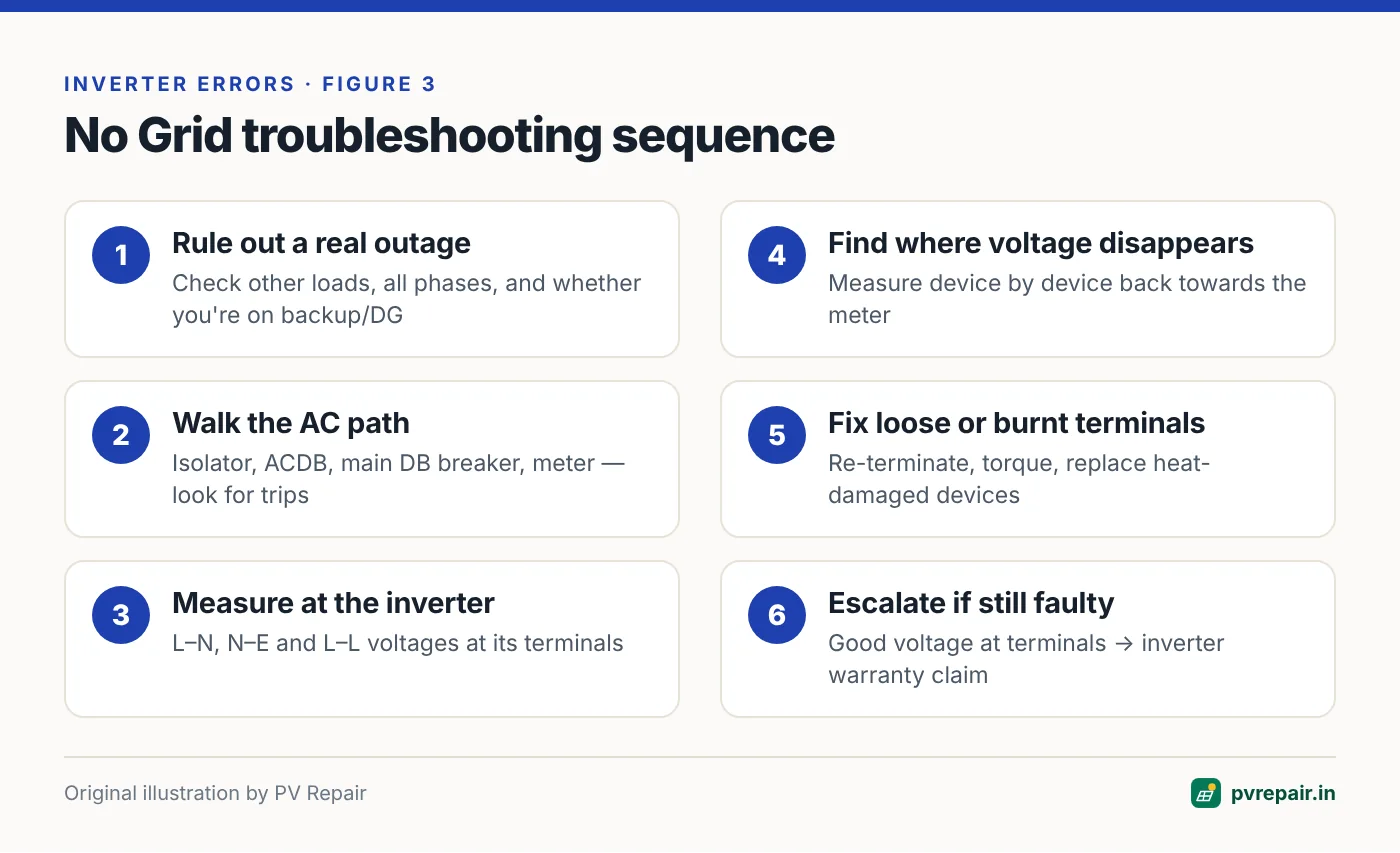
Step 1: Confirm it isn't a real outage
- Check if other loads are working, including on all three phases if you have a three-phase supply. In India it's common for one phase to be lost while the others remain on, which will stop a three-phase inverter.
- Check whether you're running on a backup inverter or generator. Grid-tie inverters will not (and must not) synchronise to many home UPS outputs or generators unless the system is specifically designed for it. If the house is on battery backup or DG, a No Grid message is normal.
- Check with neighbours or the DISCOM's outage information.
Step 2: Walk the AC path
The AC path for a typical rooftop system is:
Inverter AC terminals → AC isolator near inverter → solar ACDB (MCB/RCBO, SPD, sometimes a fuse) → cable to main distribution board → solar MCB in main DB → net meter → service line
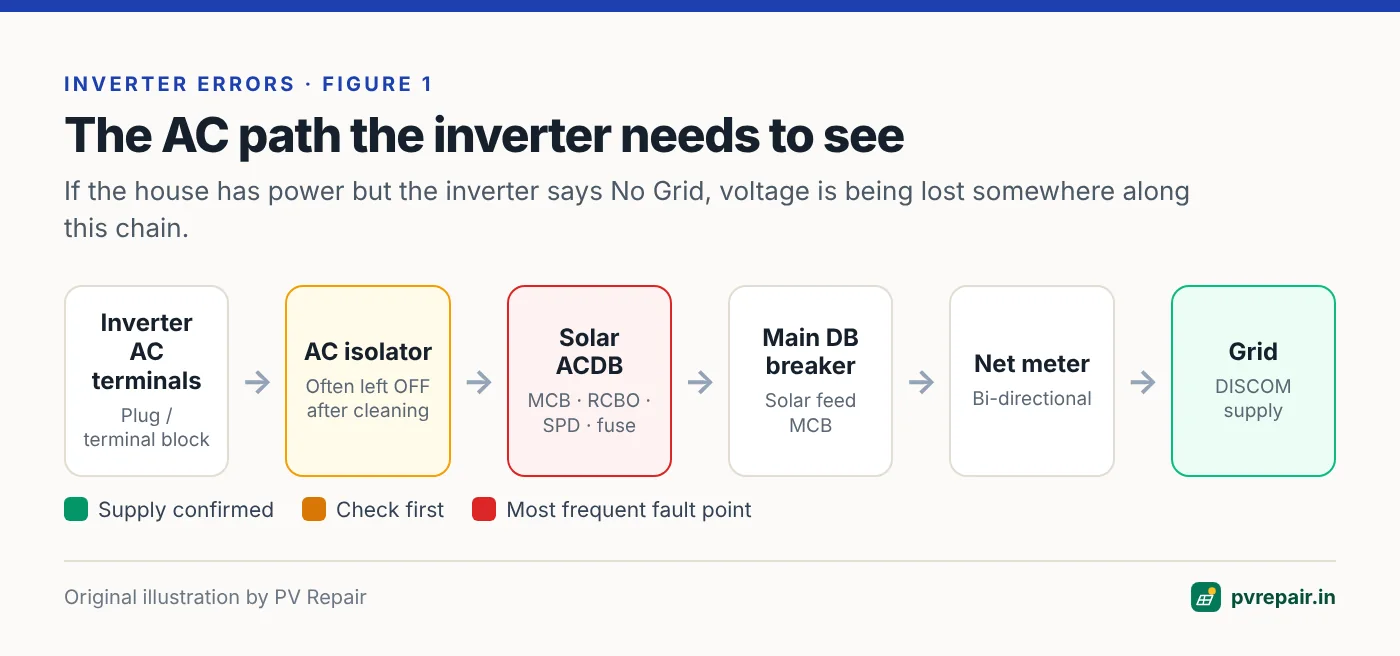
Visually check each device:
- AC isolator next to the inverter — is it in the ON position? Isolators are often switched off during cleaning or maintenance and forgotten.
- Solar ACDB — look for a tripped MCB, RCCB/RCBO or a blown fuse. Note whether an RCD has tripped, as that points to a separate earth leakage problem.
- Main DB solar breaker — has it tripped or been switched off?
- Meter — some net-metering installations include a separate solar meter or a DISCOM-sealed isolator. Check that nothing has been disconnected.
If a breaker has tripped, don't just reset it repeatedly. A breaker that trips again immediately, or trips each afternoon, indicates an overload, short circuit or earth fault that needs investigation.
AC board work is for licensed electricians
Opening distribution boards and measuring at live terminals exposes you to 230/415 V AC. The checks below involving measurement should be done by a licensed electrician with appropriate PPE.
Step 3: Measure voltage at the inverter terminals
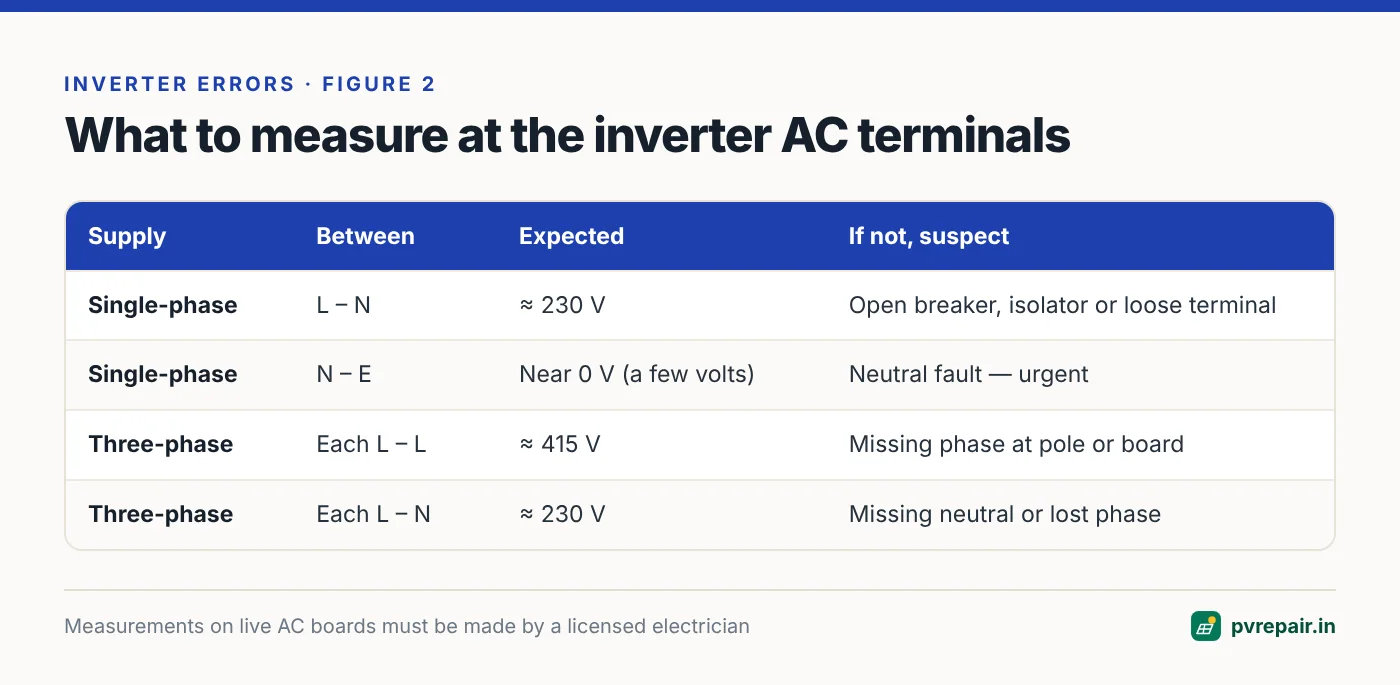
With the AC isolator ON, measure at the inverter's AC connector or the terminals of the isolator closest to it:
- Single-phase: L–N should be close to 230 V. N–E should be near 0 V (a few volts is normal; tens of volts indicates a neutral problem).
- Three-phase: each L–L should be close to 415 V, each L–N close to 230 V. A missing phase shows as a very low or zero L–N reading on that phase.
If you have correct voltage at the meter but not at the inverter, the fault lies in between. Work your way along the path measuring at each device until you find where voltage disappears.
Step 4: Look for loose and burnt connections
A loose terminal is one of the most common causes of intermittent No Grid errors. It may conduct when cool and cold, then fail when it heats up under export current in the afternoon. Signs include:
- Discoloured, melted or brown plastic around a terminal or MCB.
- A burning smell from the ACDB.
- Cables that move when tugged gently (with power off).
- Pitting or blackening on a busbar or lug.
Isolate, re-terminate using correctly sized ferrules or lugs, and tighten to the manufacturer's torque. Replace any damaged MCB or isolator — heat damage weakens the device permanently.
Step 5: Check the inverter's AC connector and internal relay
If the voltage is correct right up to the inverter's own AC connector, the problem is either the connector itself or inside the inverter.
- AC plug connectors on string inverters can be poorly assembled — a strand of wire not clamped, a screw not tightened. Re-make the connection carefully.
- Internal relay or measurement faults will usually generate a separate error (Relay Check Failure, Grid Relay Fault) but may show as a grid error on some models. If the inverter reports No Grid with confirmed good voltage at its own terminals, contact the manufacturer for warranty support.
Three-phase specific causes
Three-phase inverters need all three phases and, in most cases, neutral. Watch for:
- A missing neutral. Some installers omit neutral on three-phase inverters that require it. The inverter cannot measure phase voltages correctly and reports a grid fault.
- Phase sequence. Most inverters are not sensitive to phase rotation, but some report an error if phases are swapped. Check the manual.
- One phase blown at the pole. Common during storms in many regions. The rest of the house may work if critical loads are on the surviving phases.
Hybrid inverter cases
Hybrid inverters with battery backup have both a grid input and a backup (EPS/load) output. A No Grid message while the backup output is still powering loads means the hybrid has correctly switched to off-grid mode. Check:
- Whether the grid input breaker (not the load breaker) is tripped.
- Whether the grid and load cables have been swapped at the inverter terminals — this happens surprisingly often on new installations.
- Whether a CT or smart meter communication fault is being reported separately.
When the grid is "present but bad"
Sometimes the voltage looks fine on a meter, but the inverter still refuses. Potential reasons:
- Frequency outside range. Rare on the main grid, but common when the supply is coming from a generator.
- Excessive harmonic distortion from nearby industrial loads.
- The reconnection timer. After any grid event, inverters wait a mandated period before reconnecting, often 60 seconds to several minutes. During this time some models still show the last grid fault.
Typical scenarios and what they usually turn out to be
The same symptoms come up again and again. These composite scenarios show how the checks above narrow things down quickly.
"It stops every afternoon around 2 p.m. and comes back by evening." A fault that appears at the hottest, highest-current part of the day and clears as things cool is the signature of a loose or oxidised terminal. Thermal expansion opens the contact under load. The usual culprit is an MCB terminal in the solar ACDB, or the inverter's own AC plug. A thermal camera or an infrared thermometer pointed at the ACDB during export often shows one terminal running far hotter than the others. Re-terminate it and replace the device if the plastic is discoloured.
"The three-phase inverter says No Grid but the house is fine." The household may be running on two healthy phases while the third is lost at the pole fuse or service cable. Single-phase loads on the healthy phases keep working, so nobody notices. Measure L–N on all three phases at the main board. If one reads near zero, the DISCOM needs to restore it. The inverter is behaving correctly.
"After the electrician fitted a new DB, solar stopped working." When distribution boards are replaced, the solar feed is sometimes moved to an RCCB-protected section that trips on the inverter's normal leakage. Sometimes the solar breaker is simply left off, or neutral is not carried across. Check the new board against the original single-line diagram, and confirm the RCD type and rating match the inverter manual.
"The app says No Grid but the inverter screen shows normal." Monitoring platforms sometimes display a stale status after a Wi-Fi drop. Check the inverter's own display first. If it is generating, the issue is communication, not the grid. See our guide to monitoring and Wi-Fi problems.
Preventing repeat faults
- Use correctly rated cable and lugs, and tighten all AC terminations to the specified torque at installation.
- Recheck and retighten AC terminations during your annual maintenance — thermal cycling loosens screws over time.
- Label all solar isolators clearly so they aren't switched off by mistake.
- Place the ACDB where it is protected from rain and direct sun.
Frequently Asked Questions
Why does my solar inverter say No Grid during a power cut?
That's correct behaviour. Grid-tie inverters must disconnect when the grid fails so they don't energise lines that workers may be repairing. Your system will restart automatically when the grid returns. If you want solar power during outages, you need a hybrid inverter with battery backup.
My house has power but the inverter shows No Grid. What should I check first?
Check the AC isolator next to the inverter and the breakers in the solar AC distribution box and main DB. Most cases are a tripped breaker or a switched-off isolator.
Can a loose wire cause an intermittent No Grid error?
Yes. A loose terminal can make and break contact as it heats up under load, causing the inverter to drop off the grid repeatedly, especially in the afternoon. It's also a fire risk and should be fixed promptly.
Will my inverter work with a diesel generator?
Standard grid-tie inverters are not designed to run with a generator and can damage it or trip on frequency instability. Systems that combine solar and DG need a dedicated controller to limit solar output. Speak with your installer before connecting the two.
Related guides
PV Overvoltage Error: When String Voltage Exceeds Your Inverter's Limit
Why PV overvoltage alarms appear on cold, bright mornings, how to calculate maximum string voltage with temperature correction, and how to fix an oversized string before it damages the inverter.
How to Read Solar Inverter Fault Codes: A Universal Guide for Any Brand
Inverter error codes look cryptic, but almost every brand groups them into the same handful of categories. Learn to decode any fault code, use the event log, and decide what you can check yourself.
Solar Inverter Not Turning On? A Systematic Diagnosis From Panels to Display
Blank screen, no LEDs or stuck on "Waiting"? Work through the DC supply, start-up voltage, isolators, fuses and internal faults in the right order to find why your solar inverter won't start.