Delamination, Backsheet Cracks and Broken Glass: Can a Damaged Solar Panel Be Repaired?
How to recognise delamination, backsheet cracking, chalking and broken glass on solar modules, why each one is a safety and performance risk, and which repair options are realistic versus when replacement is the only safe choice.
A solar module is a laminated sandwich: glass on the front, a layer of encapsulant (usually EVA or POE), the cells, another layer of encapsulant, and a backsheet (or a second sheet of glass in glass-glass modules), all held in an aluminium frame. That sandwich has two jobs that matter for the next 25–30 years: let light in, and keep water and people out of a circuit that may be at 1000 V or more.
When any layer of the sandwich fails — the encapsulant separates, the backsheet cracks, the glass breaks — both jobs are compromised. Performance usually falls, but the bigger issue is safety: the module's electrical insulation is no longer reliable. This guide covers how to recognise each type of physical damage, the risks involved, and what can realistically be repaired.
Quick answer
Delamination (layers separating), backsheet cracking or chalking, and broken glass all compromise a module's insulation and allow moisture in, leading to power loss, isolation and residual current faults, and potential shock and fire risks. Minor backsheet cracks can sometimes be temporarily sealed with certified repair tapes or coatings as a stop-gap. Delaminated modules and broken glass generally require replacement. Always isolate damaged modules safely and document them for warranty or insurance claims.
Delamination
What it looks like
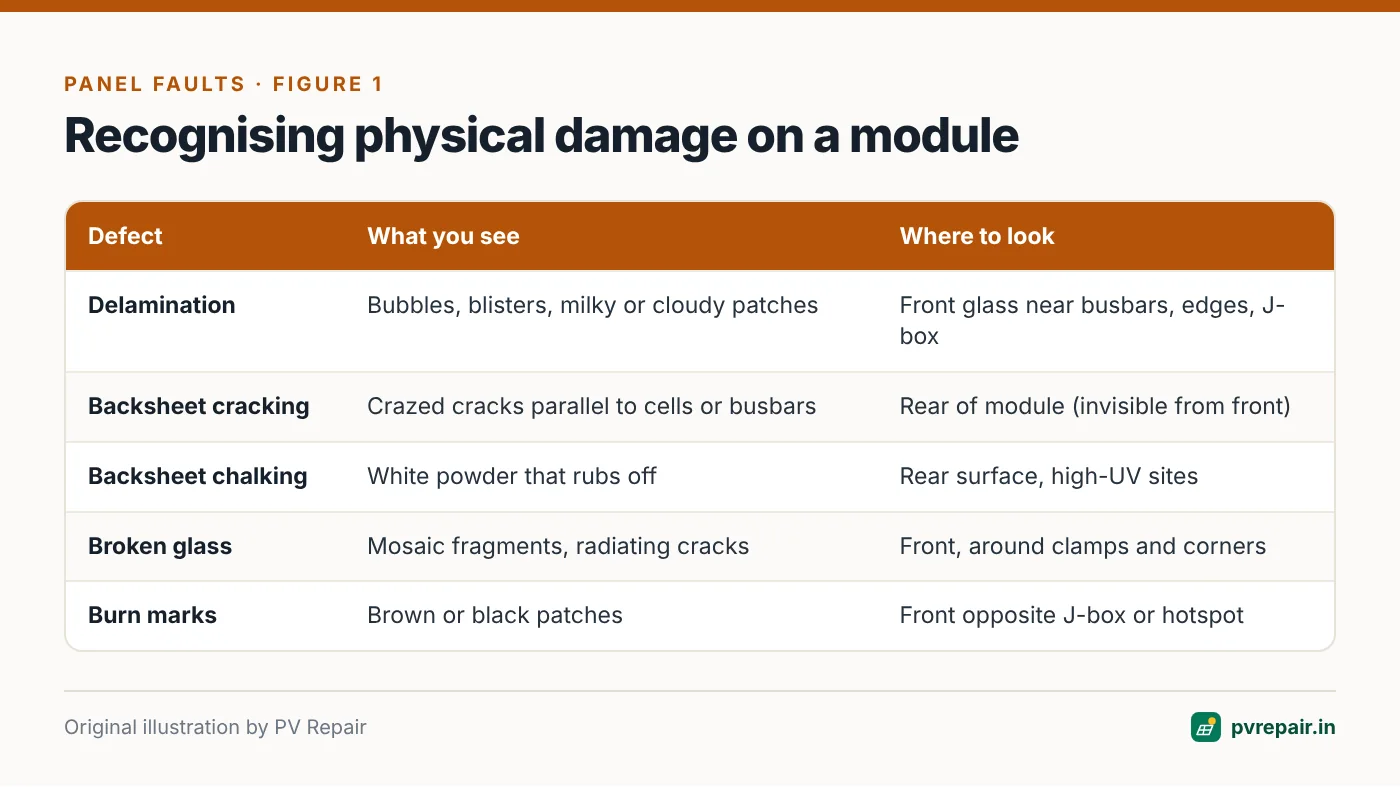
Delamination is the separation of layers within the laminate. You may see:
- Bubbles or blisters under the glass, often near cell edges, busbars or the junction box.
- Milky or cloudy patches, where the encapsulant has lost adhesion and adhesion gaps scatter light.
- Bubbles on the backsheet, bulging outward.
- Edge delamination, starting from the frame and working inward.
Why it happens
- Manufacturing issues: incomplete lamination (wrong temperature, pressure or time), contamination, or poor-quality encapsulant.
- Moisture ingress: water penetrating at edges or through the backsheet weakens adhesion.
- Heat and UV: long-term exposure degrades the encapsulant and adhesion layers, especially in hot climates.
- Hotspots: localised heating can create bubbles in the encapsulant around a defective cell or a hot junction box.
Why it matters
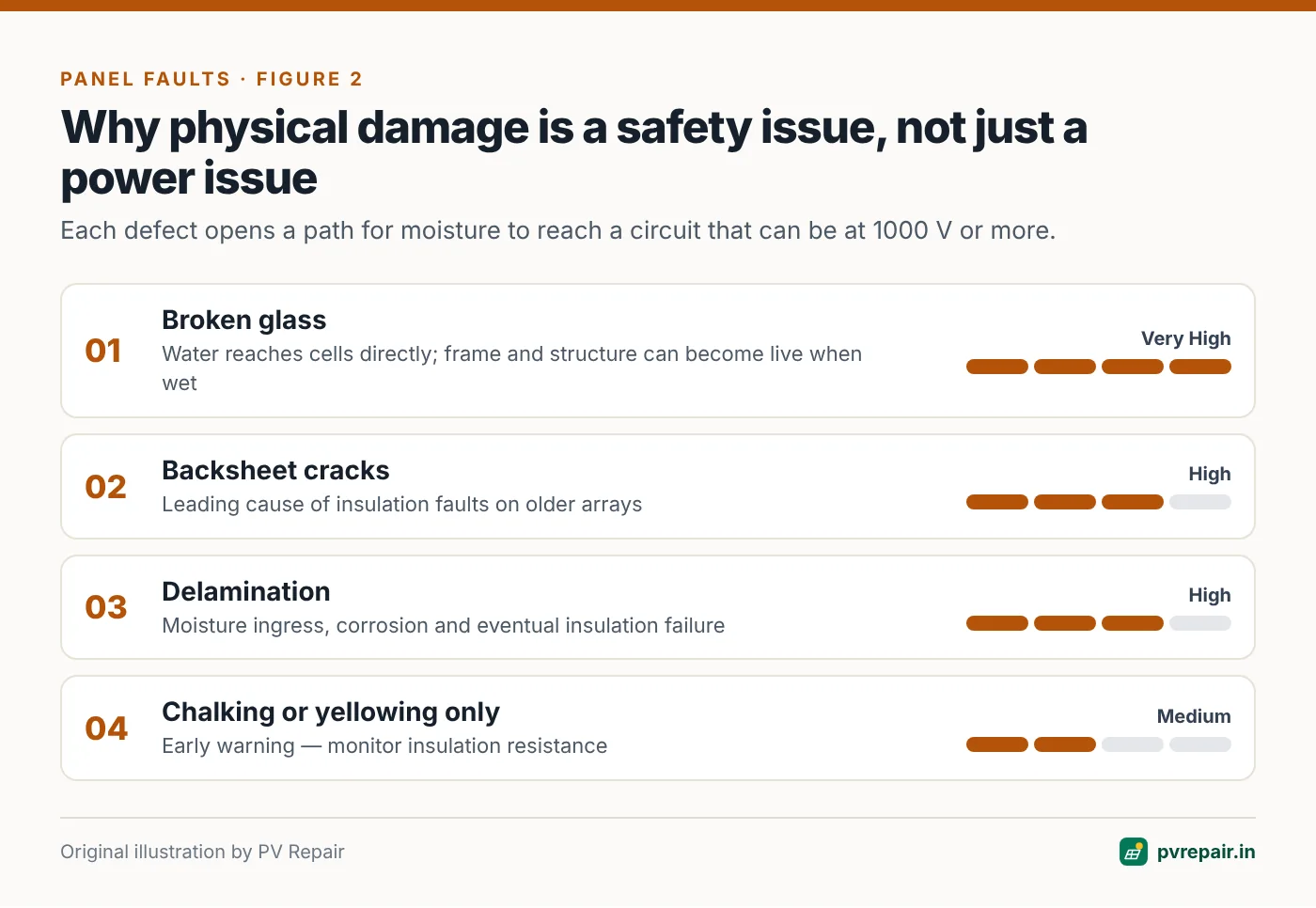
Delamination lets light scatter and reflect away from cells, reducing power. More importantly, it creates paths for moisture to reach cells and conductors, causing corrosion of the cell metallisation and ribbons and degrading insulation. Over time, delaminated modules commonly develop isolation faults and residual current trips, and bubbles near busbars can lead to arcing.
Backsheet cracking and chalking
What it looks like
- Cracks, often running parallel to the cells or along busbar lines on the rear, sometimes visible as a crazed pattern.
- Chalking — a powdery white surface that rubs off on your fingers.
- Yellowing or browning of the backsheet.
- Peeling of the outer backsheet layer.
Why it happens
Backsheets are multi-layer polymer films. Some materials used in the past — certain polyamide (PA)-based backsheets in particular — have shown widespread cracking in the field after several years, especially in hot, high-UV environments. Thermal cycling, UV from ground reflection (particularly on light-coloured roofs and ground-mounted systems with high albedo), and mechanical stress all contribute.
Why it matters
The backsheet is the main electrical insulation on the rear of the module. A crack exposes the inner layers and eventually the cell circuit to moisture. On a wet morning, current can leak from the cells through the crack to the earthed frame or mounting structure — a direct cause of isolation faults, residual current faults, and shock risk to anyone touching a wet structure. Cracked backsheets are one of the leading causes of insulation faults on older arrays.
Broken glass
What it looks like
- Shattered tempered glass — tempered glass breaks into a mosaic of small fragments, often held together by the encapsulant, so the module may still look intact from a distance.
- Cracks radiating from an impact point or a corner.
- Spider-web patterns around a frame clamp location.
Why it happens
- Impacts from hail, falling objects, tools or stones.
- Clamping too tightly or outside the manufacturer's clamping zones.
- Frame distortion during installation or from a structure that isn't flat.
- Thermal stress, especially if a hotspot or junction box overheats.
- Spontaneous breakage due to nickel sulphide inclusions in tempered glass (rare).
- On glass-glass modules, mounting and handling stresses that the module wasn't designed for.
Why it matters
Broken glass allows water straight into the module. Even if the module still produces power — and broken modules often continue to produce near their normal output for a while — its insulation is compromised. In wet conditions, a broken module can make its frame and the surrounding structure live. It's also a physical hazard during cleaning and maintenance.
A broken module is still live
A module with broken glass continues to generate voltage in daylight and may have exposed conductors. Do not touch it with bare hands, do not walk on it, and do not spray it with water. Isolate the string and replace the module as soon as practical.
Safe handling of damaged modules
- Switch off the inverter (AC then DC isolator) so no current is flowing in the string.
- Open string fuses or isolators for the affected string.
- Use insulated gloves and safety glasses, and work in low light or cover the module with an opaque sheet before disconnecting.
- Disconnect at the connectors of the damaged module and cap them with matching insulated caps if available.
- Remove the module carefully — broken glass can come loose in fragments.
- Document the module's serial number, damage, and the conditions.
- Insulation-test the remaining string before reconnecting.
Repair options
Backsheet repair tapes and coatings
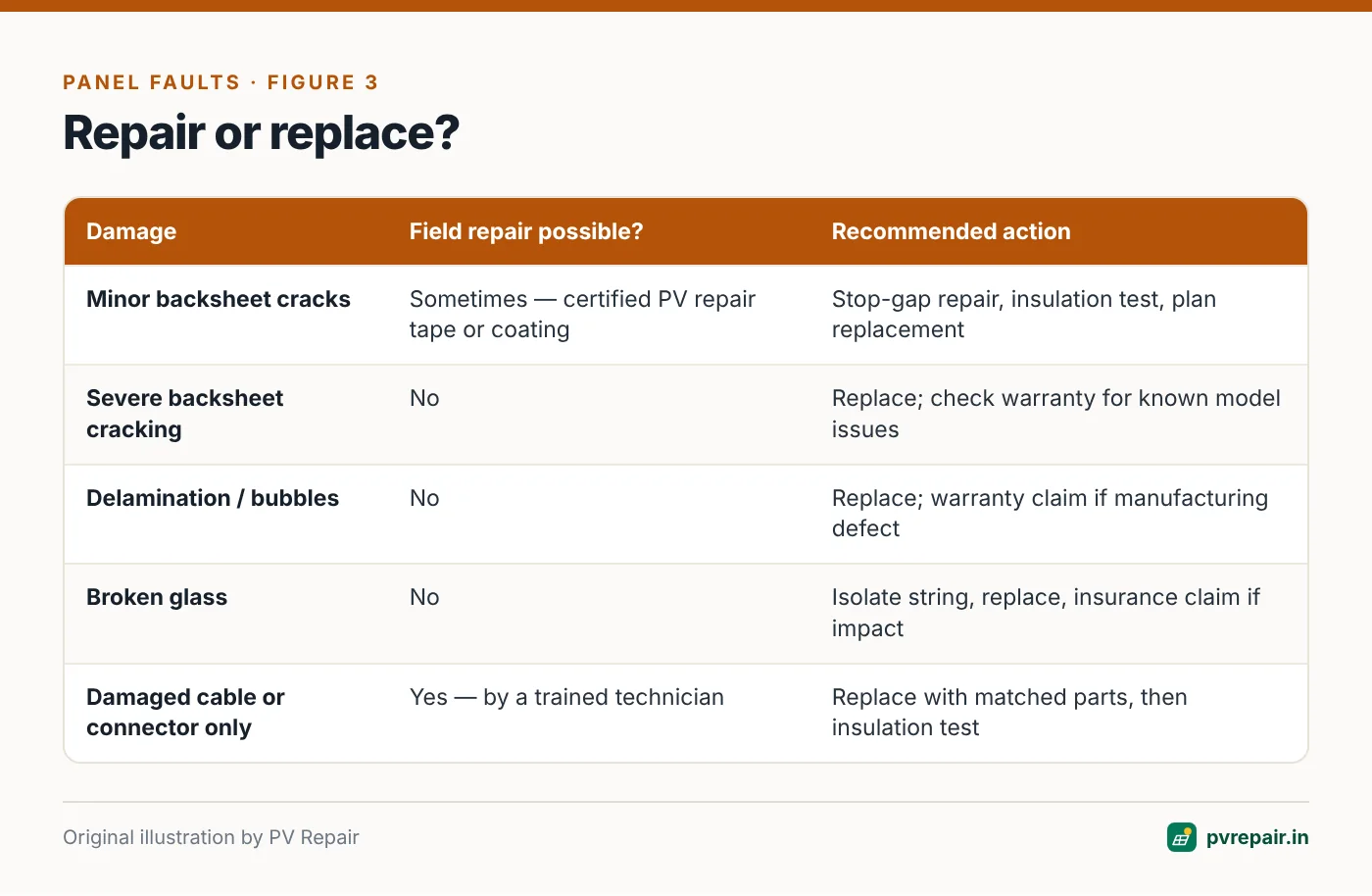
For backsheet cracking, specialised repair products exist: adhesive backsheet repair tapes and liquid coatings designed to restore an insulating barrier over cracked areas. They can be a useful way to reduce insulation faults on a large fleet of affected modules while a long-term replacement plan is made, or for modules that otherwise perform well.
Limitations:
- The product must be specifically certified or tested for PV backsheet repair, with appropriate UV, temperature and electrical insulation properties. General-purpose tapes and sealants are not acceptable.
- The backsheet must be cleaned and prepared exactly as the product requires; poor adhesion will fail quickly.
- Repairs typically need modules to be accessed from the rear, which may be difficult on rooftops.
- Repair may affect warranty terms. Check with the module manufacturer first.
- Repaired modules should be insulation-tested after the work.
Glass and delamination repairs
There is no reliable field repair for broken glass or significant delamination that restores the module's original safety. Some products are marketed for "sealing" cracked glass, but they don't restore the structural and insulating properties of tempered glass. Replace the module.
Replacement
Replacement is the safe default for broken glass, delamination, severe backsheet damage, and any module that fails an insulation test. Choose a replacement module that matches the string's electrical characteristics as closely as possible, particularly current at maximum power. If the original model isn't available, an installer can choose a compatible module and confirm that the string's voltage stays within inverter limits.
Inspecting the rear of rooftop modules
Backsheet problems are invisible from the front, and on low-tilt rooftop arrays the rear of modules is hard to see. A few practical approaches help:
- Use the gaps. At the ends of rows and between rows, you can often see the rear of edge modules with a torch. Edge modules are also the most exposed to reflected UV, so they're a good indicator for the rest of the array.
- Use a camera on a pole or a small inspection mirror to look under modules without leaning on them.
- Check during module replacements. Whenever a module comes off the roof for any reason, inspect its backsheet and those of its neighbours.
- Follow the data. A string whose insulation resistance falls year after year, or that trips residual current protection after rain, is worth a closer look at the rear surfaces even if nothing is visible from the front.
Warranty and insurance
- Manufacturing defects such as delamination from poor lamination or premature backsheet failure are typically covered by the product warranty, usually 10–15 years or more for reputable brands.
- Physical damage from impacts, hail, storms or installation errors is normally not covered by the manufacturer, but may be covered by property or solar-specific insurance.
- Documentation — photos, serial numbers, insulation test results, installation date — is essential for any claim. For known backsheet issues on a particular model, manufacturers may already have a claims process.
Prevention
- Specify modules with proven backsheet materials or glass-glass construction for harsh environments.
- Clamp only within manufacturer-specified zones, at the specified torque, on a flat, true structure.
- Keep tools and materials off modules during installation and maintenance.
- Inspect the rear of modules where accessible during annual maintenance — backsheet cracking is invisible from the front.
- Trend insulation resistance over time; a gradual decline across many strings can point to fleet-wide backsheet degradation.
Frequently Asked Questions
Can a solar panel with broken glass still work?
Often it can produce power for a while, but it's no longer safe. Water can reach the cells and conductors, and the module may cause insulation faults or shock risk. Replace it.
Is backsheet cracking covered by warranty?
If it's due to a material or manufacturing defect, often yes. Several module models have had known backsheet issues, and manufacturers may have specific claims processes. Document the damage and contact the manufacturer or your installer.
Can I use silicone to seal a cracked backsheet?
No. General-purpose silicone isn't designed for PV backsheet repair and may not provide adequate insulation, UV resistance or adhesion. Use only products specifically tested for PV backsheet repair, or replace the module.
What causes bubbles in a solar panel?
Bubbles are a sign of delamination or gas formation in the encapsulant, often caused by manufacturing issues, moisture ingress or localised overheating. Modules with bubbles should be inspected and usually replaced.
Should I remove a broken module immediately?
Isolate the string and arrange replacement promptly. If replacement will take time, leaving the string disconnected is safer than running with a broken module, especially during the monsoon.
Related guides
Potential Induced Degradation (PID) in Solar Panels: Detection, Recovery and Prevention
What PID is, why it affects modules near the negative end of a string in hot, humid climates, how to recognise the pattern in data and EL images, and how anti-PID devices and design choices can recover and prevent losses.
Microcracks and Snail Trails in Solar Panels: What They Mean for Performance and Warranty
How microcracks form in solar cells, why snail trails appear along them, how electroluminescence and thermal imaging reveal cracks, and when cracked modules need replacing or a warranty claim.
Burnt Junction Box on a Solar Panel: Causes, Risks and Safe Repair Options
Why solar panel junction boxes overheat, melt and burn, how to spot the early warning signs, what to do immediately when you find one, and whether a junction box can be repaired or the module must be replaced.