Solar Earthing and Lightning Protection: Common Mistakes and How to Fix Them
The earthing and lightning protection mistakes most often found on Indian solar rooftops — unbonded frames, shared or high-resistance earth pits, long SPD leads, missing separation distances — and how to correct each one.
Earthing is the least glamorous part of a solar installation and one of the most frequently done badly. It's buried, hidden behind modules or run along parapets, and it doesn't affect generation on a normal day — so shortcuts often go unnoticed until something goes wrong. When it does, the consequences range from repeated inverter faults to destroyed equipment after a thunderstorm, or a real shock hazard for anyone touching the structure.
India has some of the highest lightning activity in the world, particularly in the eastern and north-eastern states and across much of central and peninsular India during the pre-monsoon and monsoon seasons. A rooftop solar array is a large metallic structure on the highest point of a building, connected by long cables to sensitive electronics. Getting earthing and surge protection right isn't optional.
This guide explains the purpose of each part of the system, the most common mistakes found on site, and how to fix them.
Quick answer
A solar system needs three related things: protective earthing and equipotential bonding of all exposed metal (frames, structures, enclosures), properly rated surge protection devices on the DC and AC sides connected with short leads, and — where the risk assessment calls for it — an external lightning protection system with air terminals and down conductors kept at a safe separation distance from the array. The most common mistakes are unbonded module frames, relying on anodised aluminium contact, high-resistance or shared earth pits with poor connections, long SPD leads, and lightning arresters bonded directly to the array in the wrong way.
The three jobs of an earthing system
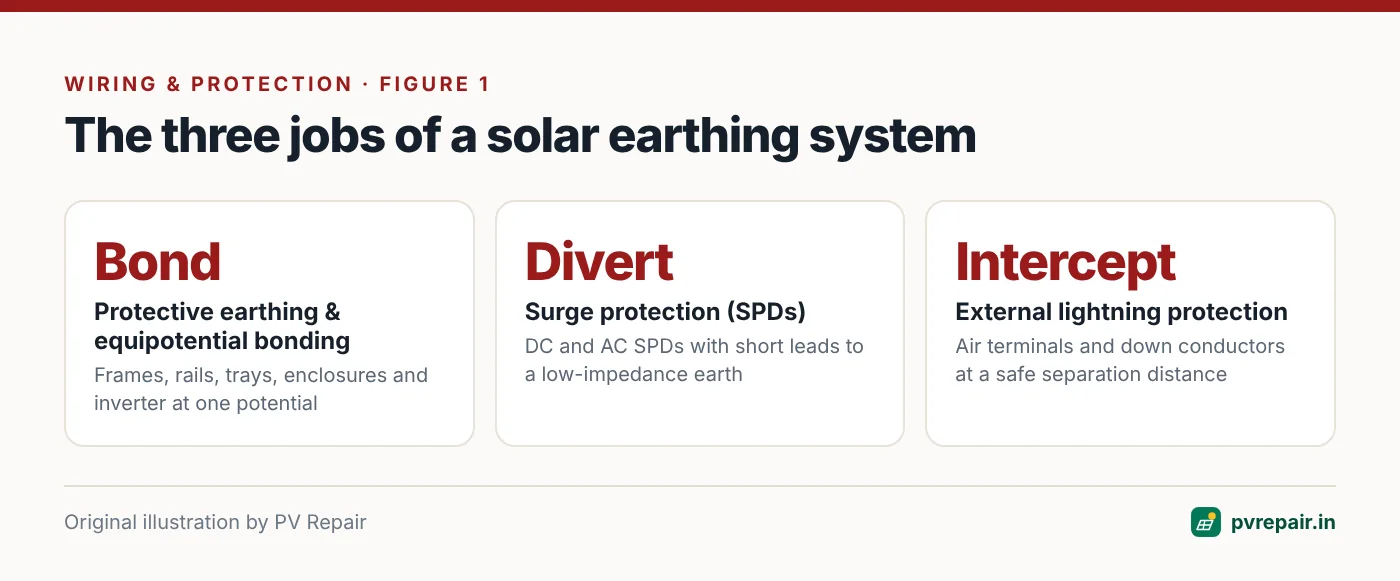
1. Protective earthing and equipotential bonding
Module frames, mounting structures, cable trays, enclosures and the inverter chassis are all exposed conductive parts. If insulation fails anywhere — a cracked backsheet, a chewed cable — they could become live. Protective earthing connects them to earth so that fault current has a safe path and protective devices or the inverter's monitoring can respond. Equipotential bonding ensures that all metal parts are at the same potential, so a person touching two of them at once doesn't receive a shock.
2. Surge protection
Surge protection devices (SPDs) on the DC side (near the inverter and, for long cable runs, near the array) and on the AC side divert transient overvoltages to earth. They depend on a low-impedance connection to the earthing system to work. See DC fuses and SPDs.
3. External lightning protection (where required)
For buildings where a risk assessment (following the IEC/IS 62305 series) indicates the need, an external lightning protection system (LPS) — air terminals, down conductors and an earth termination system — intercepts direct strikes and carries the current safely to ground. The solar array must be integrated with it correctly, either by maintaining a separation distance or by bonding it in a controlled way.
The most common mistakes
Mistake 1: Module frames not properly bonded
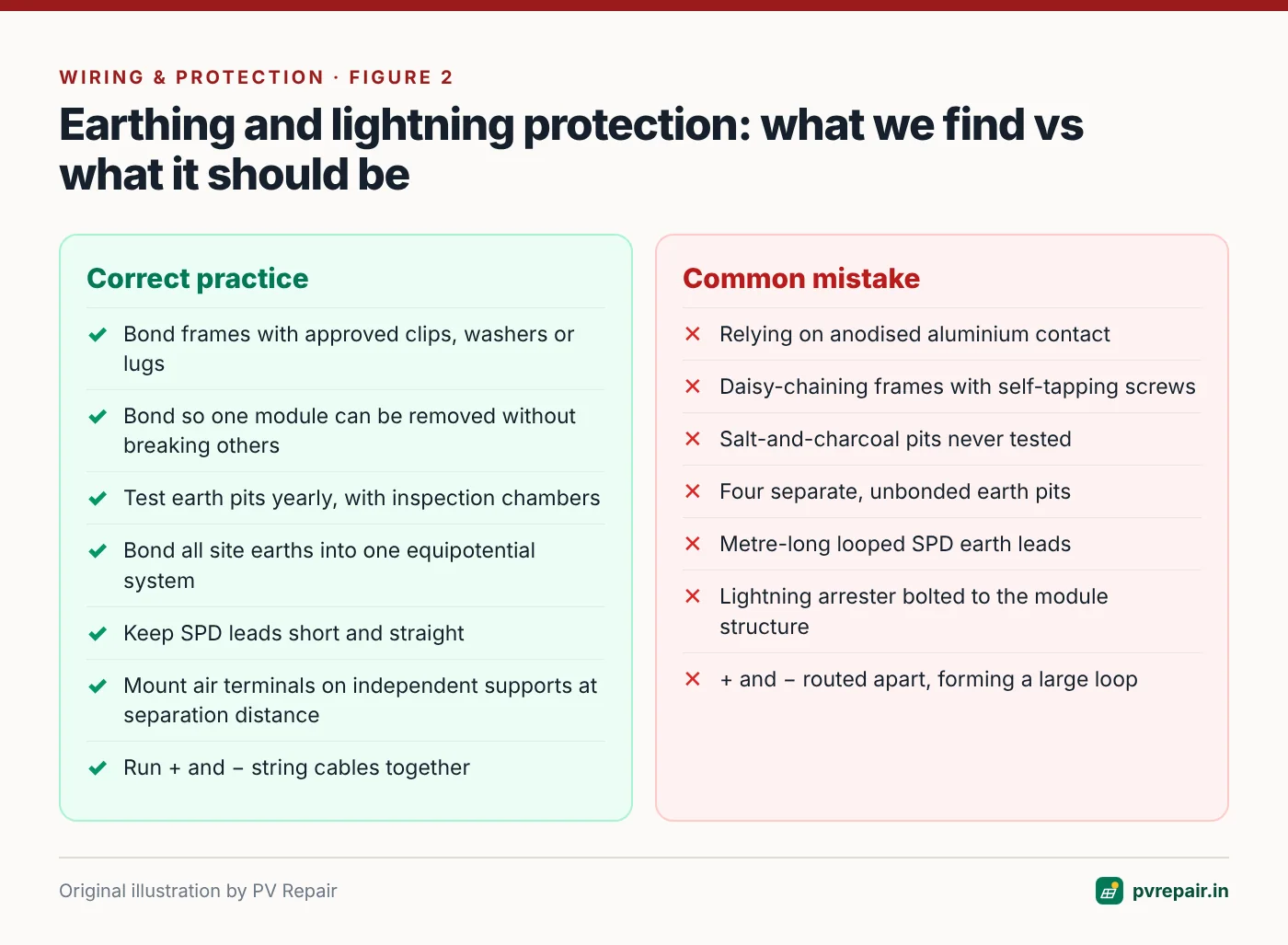
Many installers assume that bolting an anodised aluminium module frame to an aluminium or galvanised steel rail creates an electrical connection. It doesn't — anodising is an insulating layer. Without a proper bonding method, individual frames may be effectively isolated.
Fix: Use a bonding method approved by the module and mounting system manufacturers: earthing clips or washers that pierce the anodising, dedicated earth lugs on the frame's earthing holes with copper conductors, or a mounting system with certified integrated bonding. Use bi-metallic or tinned connectors where copper meets aluminium to prevent galvanic corrosion.
Mistake 2: Daisy-chaining frames with loose connections
A single earth conductor looped from frame to frame with self-tapping screws and no proper lugs will loosen and corrode. Removing one module for replacement can break the bonding for everything downstream.
Fix: Bond each module so that removing one doesn't disconnect others — for example, bonding frames to the rail, and the rails to a main earth conductor at several points.
Mistake 3: High-resistance or poorly made earth pits
Earth pits that were never tested, pits filled with salt and charcoal that dried out or corroded the electrode, undersized electrodes, and corroded connections at the electrode clamp all lead to high earth resistance. Many specifications in India call for a combined earth resistance of a few ohms (5 Ω is a common target in tenders, with lower values for some applications), but the right value depends on the design and applicable standards.
Fix: Install earth electrodes according to IS 3043 practice and the project specification, use maintenance-free chemical earthing compounds where specified, provide inspection chambers so connections can be checked, and test earth resistance at commissioning and annually with an earth tester. Record results and seasons — earth resistance is usually highest in the dry season.
Mistake 4: Separate, unbonded earthing systems
Some installations have one earth pit for the solar DC side, another for the inverter, another for the building's AC system and a fourth for the lightning arrester, with no connection between them. During a lightning strike or fault, these systems can rise to very different potentials, driving surge current through equipment that bridges them — typically the inverter.
Fix: Earthing systems on a site should generally be bonded together to form a single equipotential system, in line with applicable standards and the design. Lightning protection earths are bonded to the main earthing system at ground level. Get a qualified designer to review existing multi-pit installations.
Mistake 5: Long, looped SPD connection leads
An SPD can only protect equipment if its leads are short. During a surge, the inductance of a long connecting lead creates a large voltage drop, which adds to the SPD's clamping voltage. A metre of looped cable can add hundreds of volts.
Fix: Mount SPDs as close as possible to the equipment they protect and the earth bar, keep leads short, straight and of the specified cross-section, and avoid loops.
Mistake 6: Lightning arrester mounted on the module structure
A common rooftop sight is a lightning arrester (air terminal) fixed directly to the module mounting structure, with a thin down conductor clipped to the structure. In a direct strike, this injects lightning current into the PV structure and right next to the DC cables, potentially destroying modules, cables and the inverter.
Fix: Install air terminals on independent supports, positioned so the array is within the protected zone and maintaining the separation distance calculated per IEC/IS 62305-3. Where separation isn't possible, bonding must be designed deliberately, with appropriately rated Type 1 SPDs. Route down conductors away from DC cables.
Mistake 7: DC cables forming large loops
Positive and negative string cables routed separately — for example, down opposite sides of an array — form a large loop. A nearby lightning strike induces voltage in proportion to loop area.
Fix: Route positive and negative conductors of each string together, close to each other and to the earth/bonding conductor, to minimise loop area.
Mistake 8: Earthing conductors that are too small or not protected
Thin earthing wires that corrode or break, or earth conductors run unprotected across walkways, degrade over time.
Fix: Size earth and bonding conductors to the design (commonly copper or aluminium of specified cross-section, or galvanised steel strip for structural bonding), protect them mechanically, and use corrosion-resistant connections.
Testing your earthing system
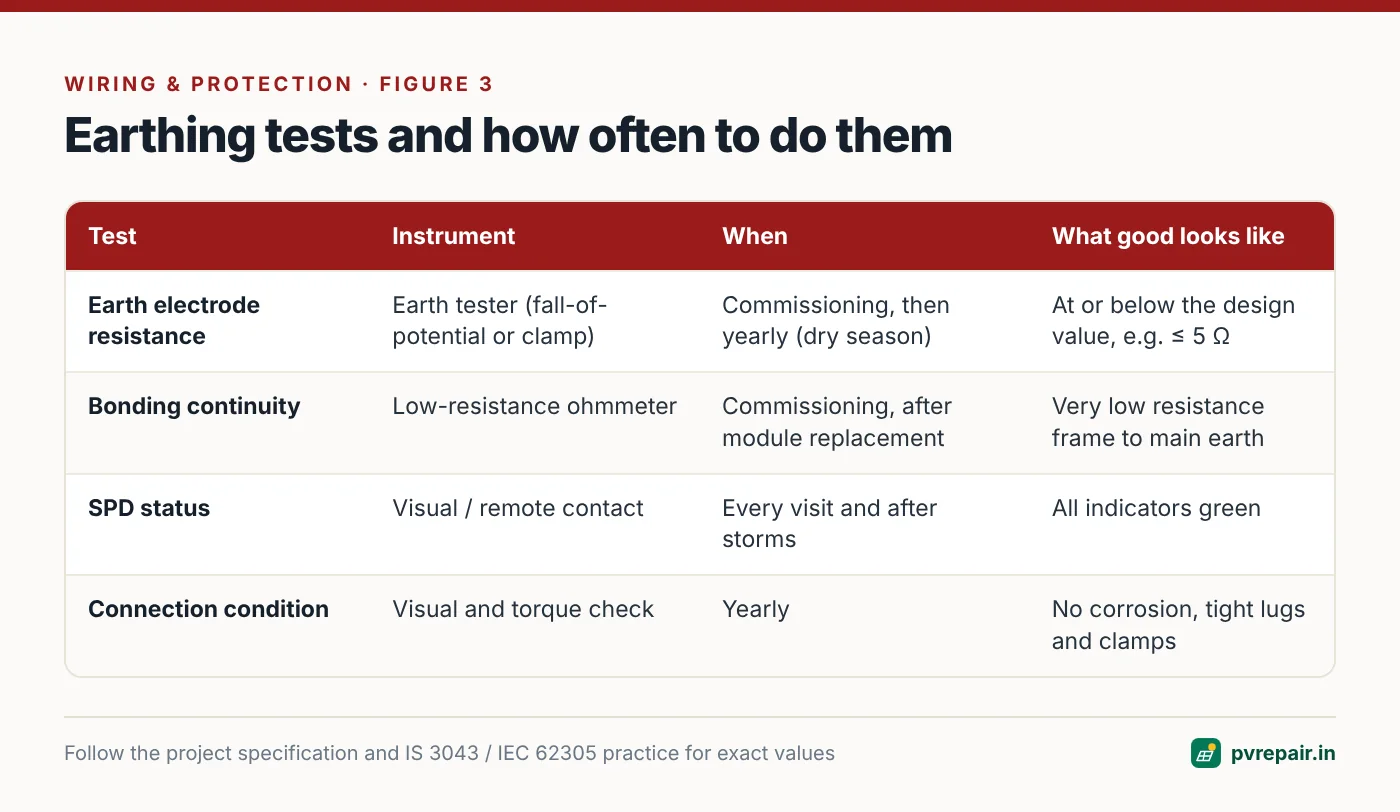
- Earth electrode resistance with an earth tester (fall-of-potential or clamp method), at commissioning and annually.
- Continuity of bonding from each frame and structure section to the main earth terminal with a low-resistance ohmmeter.
- Visual inspection of clamps, lugs and conductors for corrosion and looseness.
- SPD status indicators, especially after thunderstorms.
- Insulation resistance of strings — not part of earthing itself, but problems in either show up as isolation or residual current faults.
After a lightning event
If lightning strikes the building or nearby:
- Check for visible damage (scorched cables, burnt SPDs, cracked modules).
- Check SPD indicators and replace any failed cartridges.
- Check the inverter for faults and confirm it restarts normally.
- Test string insulation resistance and Voc to detect damaged modules or bypass diodes — see bypass diode failure.
- Document everything with photos and dates for insurance.
Frequently Asked Questions
Do solar panels attract lightning?
Solar panels don't attract lightning more than any other structure of similar height and shape. But they add a large metal surface to the roof, connected by long cables to electronics, so they're vulnerable to induced surges and to direct strikes if the building is struck.
Is a lightning arrester mandatory for rooftop solar in India?
Requirements depend on the building, the project specification and the applicable regulations and risk assessment. Many DISCOM and subsidy scheme specifications include lightning protection. Where one is installed, it must be designed and positioned correctly, not just fixed to the module structure.
What earth resistance should my solar system have?
Many Indian project specifications call for a low earth resistance — commonly 5 Ω or less for the combined system — but the correct value depends on the design and standards applied. Test regularly and keep records.
Can I use the building's existing earth for solar?
Often the solar earthing is connected to, and forms part of, the building's main earthing system, which is good practice for equipotential bonding. The existing earth must be in good condition and adequate for the additional system. Have a qualified electrician assess it.
Why do my inverters fail after every thunderstorm?
Repeated surge damage usually points to poor earthing, missing or failed SPDs, long SPD leads, large cable loops, or lightning protection that injects current into the array. A professional review of the earthing and surge protection design is worthwhile.
Related guides
Rodent, Monkey and Bird Damage to Solar Cables: Prevention and Repair
How rats, squirrels, monkeys and pigeons damage rooftop solar systems in India, the faults they cause, and proven prevention methods — conduit, cable trays, mesh skirts and bird deterrents — plus safe repair of chewed cables.
DC Arc Faults in Solar Systems: Warning Signs, Detection and Prevention
What DC arcs are, why they're more dangerous than AC arcs, the difference between series and parallel arcs, how arc fault detection (AFCI) works in inverters, and the installation practices that prevent arcing.
Blown DC Fuses and Failed Surge Protection Devices in Solar Combiner Boxes
Why string fuses blow and SPDs fail in solar DC combiner boxes, how to size gPV fuses correctly, how to read SPD status indicators, and how to replace both safely without creating new problems.