Solar Inverter Not Turning On? A Systematic Diagnosis From Panels to Display
Blank screen, no LEDs or stuck on "Waiting"? Work through the DC supply, start-up voltage, isolators, fuses and internal faults in the right order to find why your solar inverter won't start.
You walk past the inverter at 11 a.m. on a sunny day and the display is blank. No LEDs, no fan, no generation in the app since yesterday. Or the screen is on but stuck on Waiting, Standby, Checking or PV Voltage Low. Before calling for a replacement, it helps to understand how an inverter wakes up, because the cause is usually outside the inverter.
This guide covers grid-tie string inverters (the most common rooftop type) and notes where hybrid and microinverter systems differ.
Quick answer
Most grid-tie inverters are powered from the solar panels, not the grid. A blank inverter in daylight almost always means no DC is reaching it: a DC isolator switched off, a blown string fuse, a disconnected or burnt MC4 connector, or a string that's open circuit. If the display is on but it won't connect, check the start-up voltage, grid presence and any fault message. Internal power supply failures do happen, but rule out the DC side first.
How a grid-tie inverter wakes up
Understanding the start-up sequence tells you where to look:
- Sunrise: the PV array voltage rises. Once it exceeds the inverter's minimum operating or control power voltage, the internal auxiliary power supply starts. The display and LEDs come on.
- Self-test: the inverter checks DC voltage against its start-up voltage, measures insulation resistance (see our isolation fault guide), and checks the grid voltage and frequency.
- Grid synchronisation: after a mandatory waiting period (often 30–300 seconds), it closes its output relays and begins exporting.
- MPPT operation: it tracks the array's maximum power point through the day.
- Sunset: voltage falls, the inverter disconnects, and eventually the display goes dark.
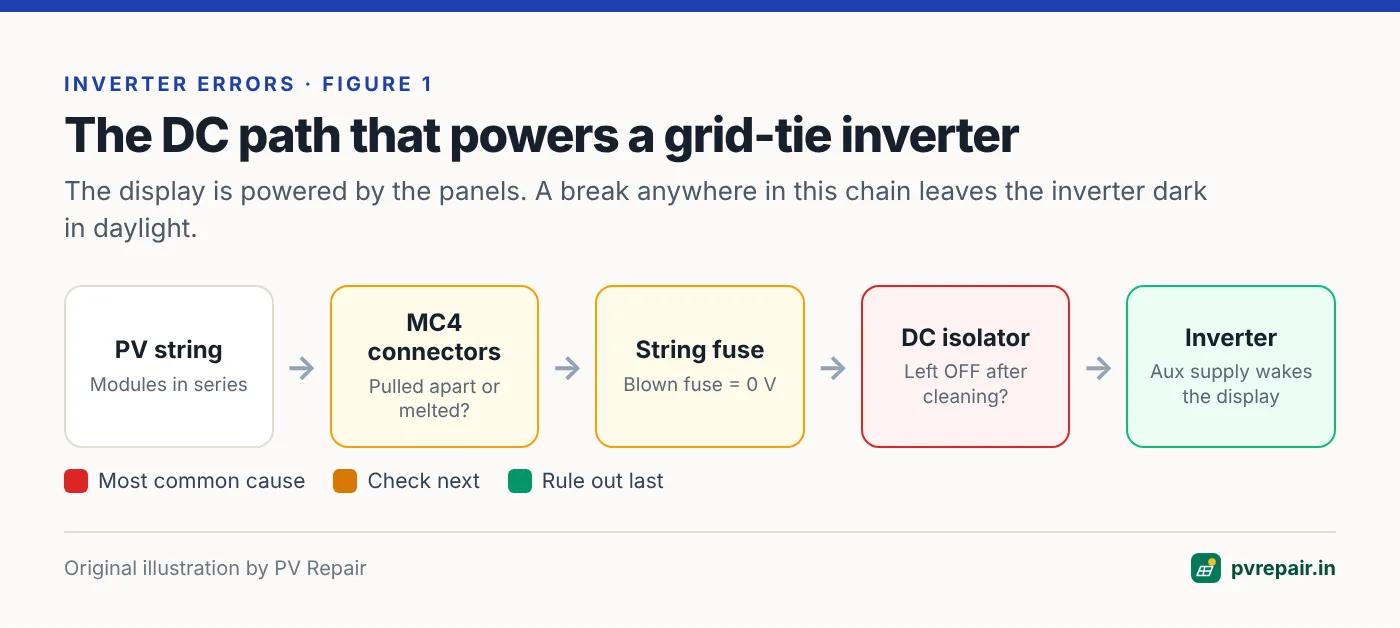
So a completely dark inverter at midday means step 1 never happened — no adequate DC voltage reached it. A lit inverter that never exports means it's failing at step 2 or 3.
Hybrid inverters are different
Hybrid inverters can also be powered from the battery and often the grid, so a blank display on a hybrid points more strongly to an internal fault, a tripped battery breaker, or a battery in protection mode. See our guide to lithium BMS errors.
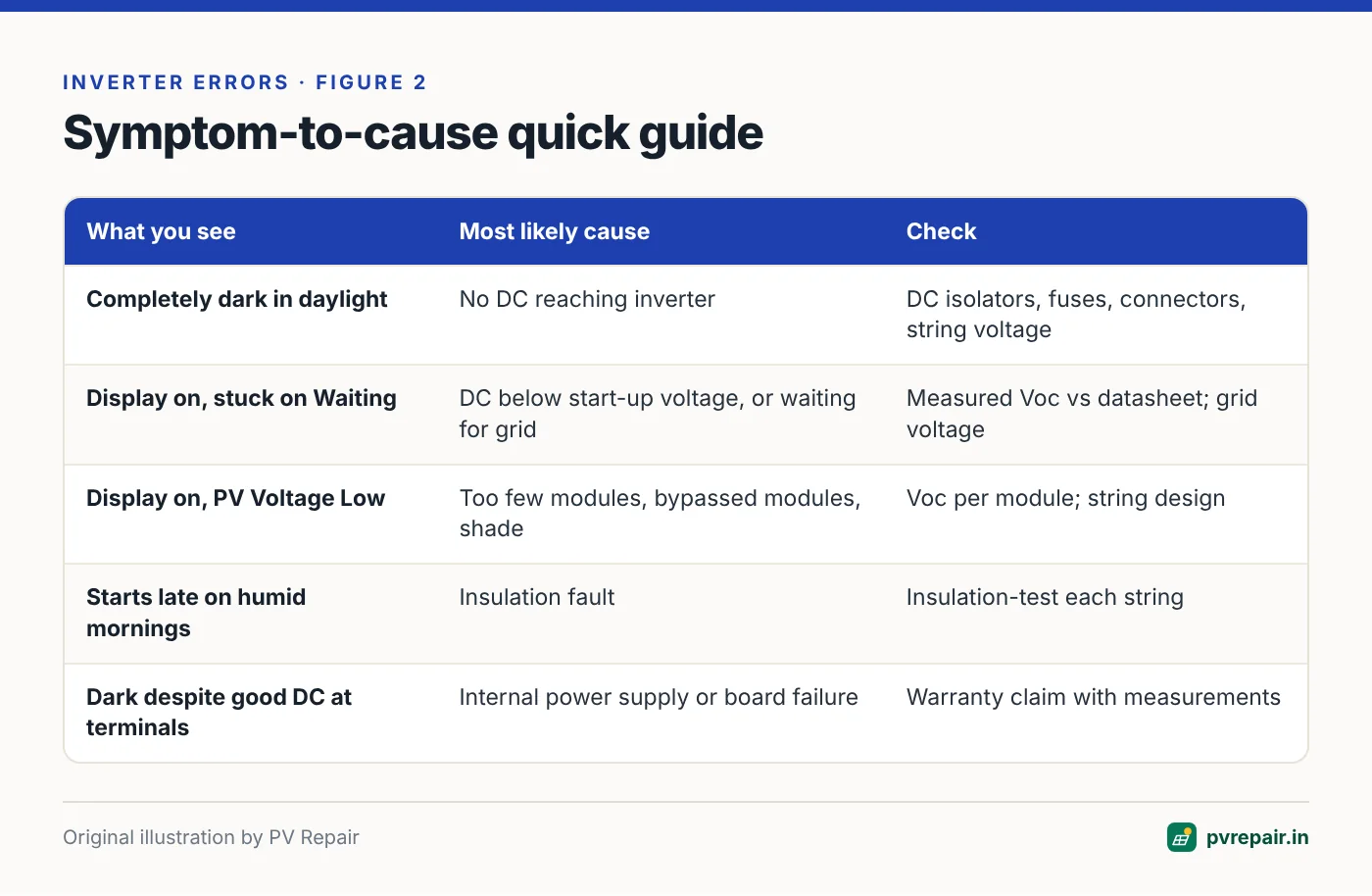
Symptom-to-cause guide
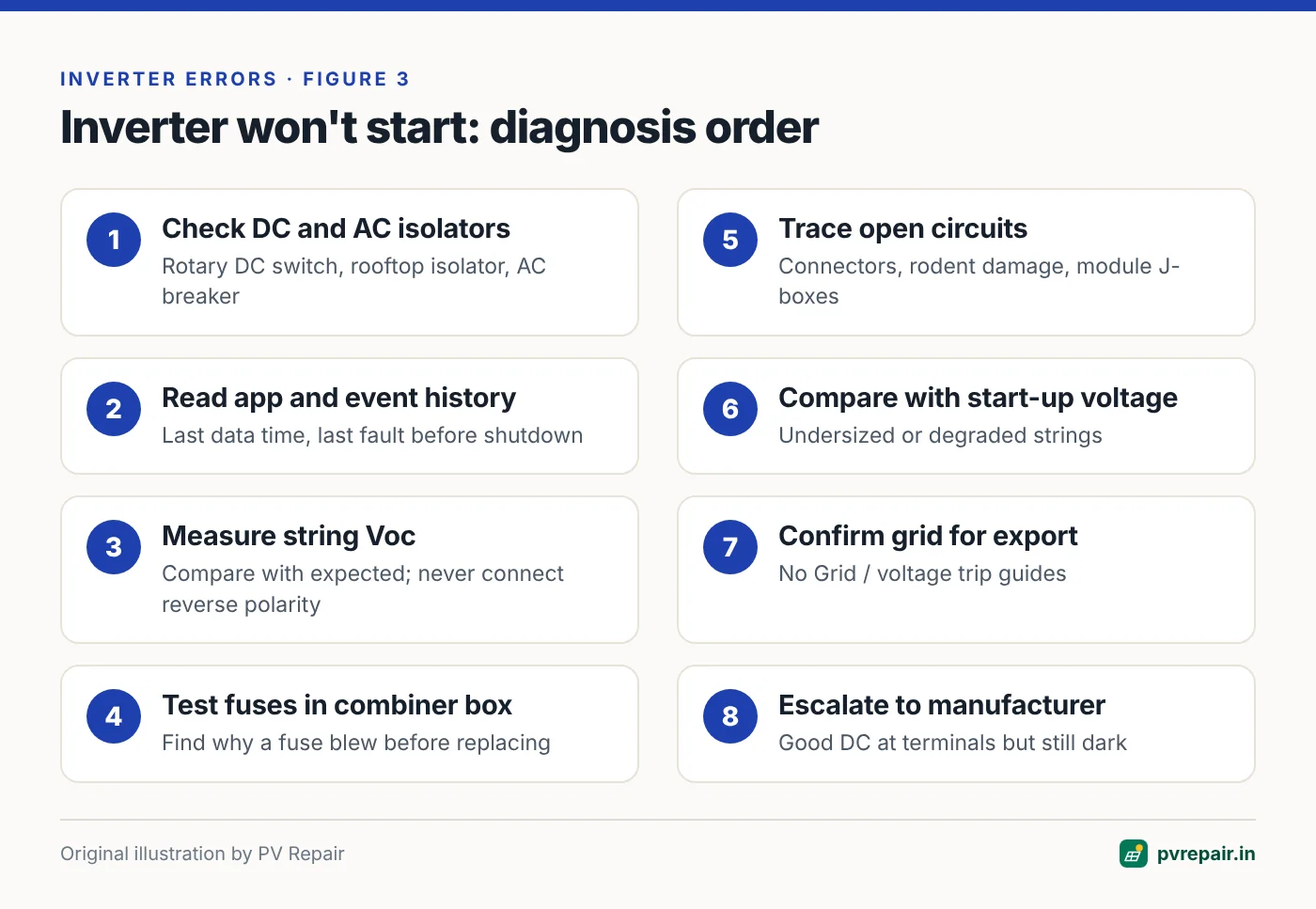
Step-by-step diagnosis
DC voltage is dangerous
A string can be at several hundred volts DC in daylight and cannot be switched off at the panels. Only trained personnel should open DC enclosures or disconnect connectors. Never disconnect an MC4 connector under load.
Step 1: Check the obvious switches
- DC isolator on the inverter (often a rotary switch on the side or bottom). It's common for it to be left OFF after cleaning or maintenance.
- External DC isolator or combiner box — rooftop or wall-mounted isolators near the array.
- AC breaker and AC isolator — not needed for the display on most grid-tie units, but needed to export.
If a DC isolator is ON but feels loose, or shows signs of heat (discoloured plastic, a burning smell), don't operate it further — DC isolators can fail internally, and a burnt isolator is a fire risk.
Step 2: Look at the inverter's own screen or app history
If the inverter has any display or Wi-Fi history, check when it last reported data and whether it logged any events before going dark. A sequence such as PV Overvoltage followed by silence, or Arc Fault followed by lockout, tells you a lot. Some inverters lock out after certain faults and need a manual reset.
Step 3: Measure DC voltage at the inverter input
With a CAT III 1000 V (or higher) rated meter and the DC isolator OFF, measure the open-circuit voltage at the string input side of the isolator, or at the string connectors before they enter the inverter (using appropriate test probes or a PV test adapter). Compare with the expected string Voc.
| Reading | What it means |
|---|---|
| Close to expected Voc | DC is reaching the inverter; problem is downstream (isolator, inverter) |
| Roughly one module's Voc short | One module bypassed or shorted — see bypass diode failure |
| Much lower than expected | Partial string connected, heavy shading, or a series fault |
| 0 V | Open circuit — blown fuse, disconnected or burnt connector, broken cable |
| Negative reading | Polarity reversed — do not connect to the inverter |
Our guide to testing a solar string with a multimeter explains how to calculate expected Voc for the temperature.
Step 4: Check string fuses and the combiner box
On systems with fuses (usually three or more strings in parallel, and most commercial systems), a blown fuse removes that string completely. Check each fuse for continuity with the system isolated. A blown fuse is a symptom, not a cause: find why it blew before replacing it. See DC fuse and SPD failures.
Step 5: Trace the string for an open circuit
If you get 0 V on a string, there is a break somewhere. Common culprits:
- An MC4 connector that has pulled apart or melted — see MC4 connector failures.
- A cable chewed through by rodents or monkeys.
- A failed junction box or internal module connection.
- A connector left unplugged after maintenance or module replacement.
Work along the string measuring voltage across each module (or groups of modules) in daylight to locate the break.
Step 6: Verify start-up voltage and string design
If the display comes on but the inverter stays in Waiting or reports PV Voltage Low, compare the measured string voltage with the datasheet's start-up voltage. A string that was designed with too few modules — or that has lost modules to bypass diode failures — may sit below start-up voltage in the morning, evening, or in hot weather, when module voltage is lower.
Step 7: Confirm grid presence for export
If DC is healthy and the inverter shows a grid-related message, follow our guides to No Grid errors and grid voltage trips.
Step 8: Suspect the inverter itself
If correct DC voltage reaches the inverter terminals with the DC isolator ON and the unit remains completely dark, the internal auxiliary power supply, control board or display may have failed. Lightning surges and power events are common triggers. Note the serial number, gather photos and measurements, and contact the manufacturer or installer for warranty support. Don't open the inverter — internal capacitors hold lethal charge and opening it may void the warranty.
Typical scenarios
"It stopped after the panels were cleaned." The cleaning crew switched off the DC isolator for safety and nobody switched it back on — or a connector was knocked apart while walking on the array. Check isolators first, then walk the strings looking for disconnected or dangling connectors.
"It died after a thunderstorm." A nearby lightning strike can damage surge protection devices, string fuses or the inverter's internal power supply. Check SPD status windows in the combiner box, test fuses, and measure DC at the inverter terminals. If DC is present and the inverter is dark, it's a warranty or insurance matter — document everything with photos and dates.
"Only one of the two MPPT inputs is working." A string fault — blown fuse, burnt connector, rodent damage — on one input. The inverter still starts on the healthy input, so this often goes unnoticed until someone compares string currents in the app.
"It starts later and later every morning." Either an insulation problem developing (Riso check failing in the morning dew) or a string voltage that's marginal for start-up. The event log usually tells you which.
Tools you'll need
- A CAT III 1000 V (or higher) rated multimeter with insulated probes, plus PV-specific test leads or adapters.
- A DC clamp meter for measuring operating current safely.
- An insulation resistance tester for isolation checks.
- Insulated gloves and safety glasses rated for the system voltage.
- The inverter installation manual and the single-line diagram for the site.
Microinverters and optimisers
With microinverters, each module has its own inverter and the grid is required for operation. If the whole system is dead, look at the AC side and the gateway/communications unit. If a single micro is dead, check its module connection and LED status. With power optimiser systems, each optimiser outputs a low "safe" voltage until it handshakes with the inverter, so string voltages measured with the inverter off look unusually low. That's normal — use the manufacturer's procedure for testing.
Prevention
- Label all DC and AC isolators clearly and add a "Return to ON after maintenance" tag.
- Inspect connectors, fuses and isolators during your annual maintenance.
- Fit surge protection devices and maintain proper earthing to reduce lightning damage — see earthing and lightning protection mistakes.
- Set up generation alerts in your monitoring app so a dead inverter is noticed the same day, not weeks later.
Frequently Asked Questions
Why is my solar inverter screen blank during the day?
On a grid-tie inverter, the screen is powered by the solar panels. A blank screen in daylight usually means no DC voltage is reaching the inverter — check DC isolators, fuses and connectors. If DC is present at the terminals and the screen is still blank, the inverter may have an internal fault.
Is it normal for the inverter to be off at night?
Yes. Grid-tie inverters shut down when the panels stop producing voltage. Some keep the display or communication module alive briefly from the grid, but most go completely dark.
My inverter shows "Waiting" all day. What does it mean?
It's usually waiting for a condition to be met: DC voltage above start-up level, a passed insulation check, or a valid grid. Check the screen for a secondary message or event code, and measure string voltage against the start-up voltage on the datasheet.
Can a single bad panel stop the whole inverter?
Yes. Because modules are connected in series, a single open-circuit module, connector or cable stops current flowing through the whole string. On single-string systems that means no generation at all.
How long should an inverter take to start in the morning?
Typically within a few minutes of the array reaching start-up voltage, plus the grid reconnection delay. On humid mornings, an inverter that starts much later than usual may be failing its insulation check.
Related guides
PV Overvoltage Error: When String Voltage Exceeds Your Inverter's Limit
Why PV overvoltage alarms appear on cold, bright mornings, how to calculate maximum string voltage with temperature correction, and how to fix an oversized string before it damages the inverter.
How to Read Solar Inverter Fault Codes: A Universal Guide for Any Brand
Inverter error codes look cryptic, but almost every brand groups them into the same handful of categories. Learn to decode any fault code, use the event log, and decide what you can check yourself.
Residual Current (RCD / GFCI) Fault on Grid-Tie Inverters Explained
What a residual current, leakage current or GFCI fault on a solar inverter means, how it differs from an isolation fault, and how to find wet cables, damaged insulation and nuisance-tripping RCDs.