Annual Solar PV Maintenance Checklist for Homes and Commercial Rooftops
A complete, practical annual maintenance checklist for rooftop solar in India — visual inspection, modules, structure, DC and AC wiring, inverters, earthing, batteries, monitoring and documentation — with what owners can do and what needs a technician.
Solar systems are often sold as "maintenance-free". They're certainly low-maintenance — there are no moving parts in the panels, and a good system will run for 25 years or more. But "low" isn't "zero". Dust, heat, monsoon rain, lightning, animals and simple wear take a toll on connectors, cables, structures and electronics. A yearly check catches small problems before they become expensive failures, safety hazards or months of lost generation.
This checklist brings together the routine we recommend for residential and small commercial rooftops. It's divided into what owners can safely do themselves and what needs a qualified technician.
Quick answer
Once a year — ideally just before the monsoon — have a qualified technician inspect modules, mounting, DC and AC wiring, connectors, combiner boxes, inverters, earthing and SPDs, measure string voltages and insulation resistance, thermal-scan the array, and compare performance with the previous year. Owners should check monitoring weekly, clean panels as needed, and look for visible damage, shading changes and animal activity. Keep records of everything.
When to do it
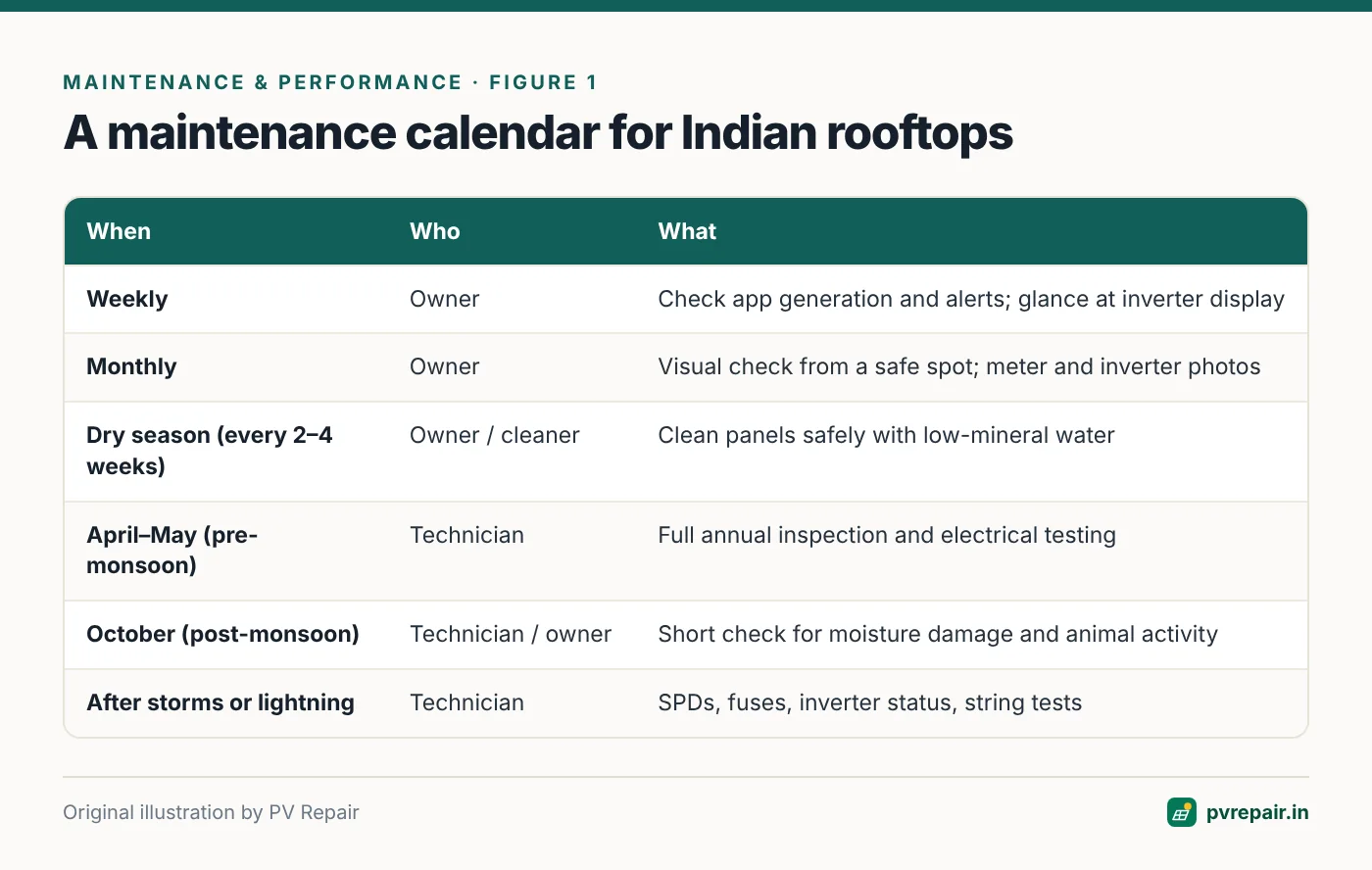
The best time for the main annual inspection in most of India is just before the monsoon (April–May in most regions). That way, connectors, seals, earthing and drainage are checked before the wettest months, when isolation faults and residual current trips peak. A short post-monsoon check (October) catches anything the rains revealed. For commercial systems, quarterly or more frequent visits are common.
Owner checks (no tools, no opening enclosures)
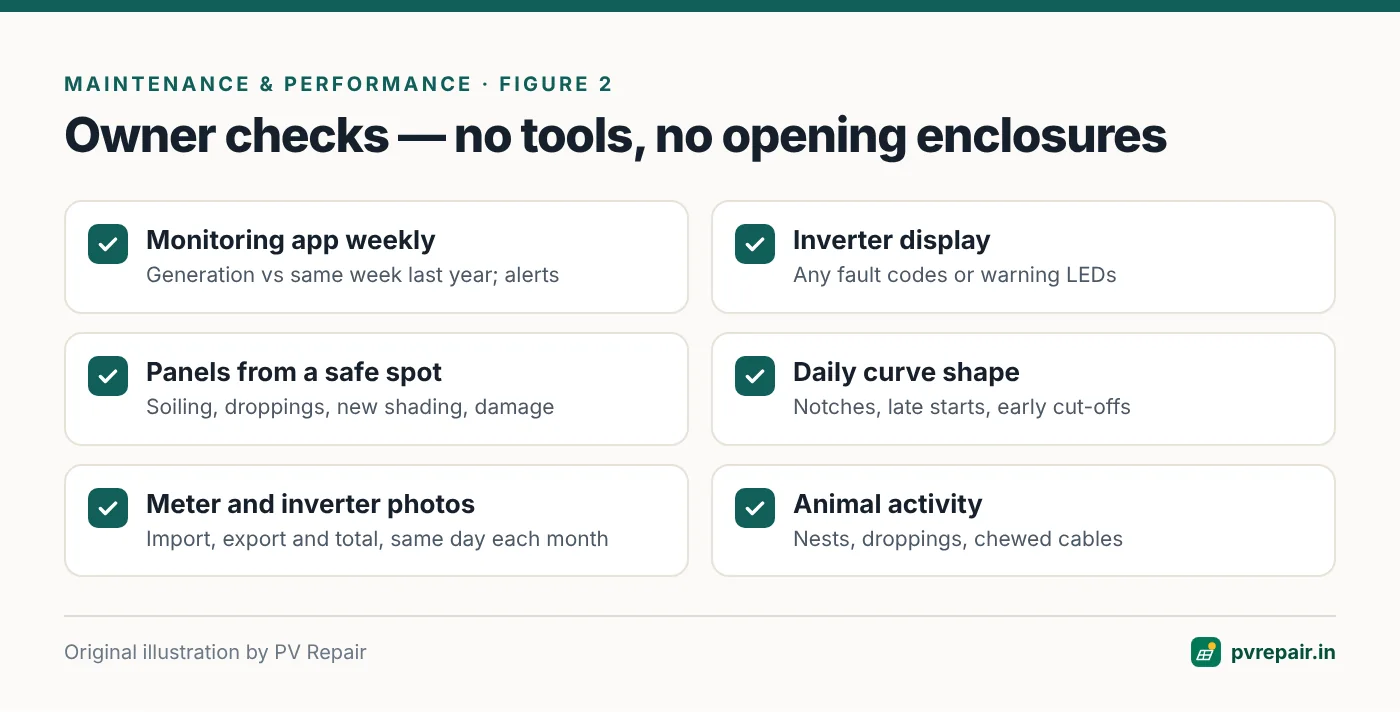
Weekly
- Check the monitoring app for generation and any alerts. Compare with the same week last year if possible.
- Glance at the inverter display for faults.
Monthly
- Look at panels from a safe position for soiling, bird droppings, debris, new shading and damage.
- Note any change in the daily generation curve — notches, early cut-offs, late starts.
- Photograph the net meter import and export registers and the inverter total. See net meter problems.
As needed
- Clean panels safely when soiling reduces output. See our cleaning guide.
- Keep the area around the inverter clear and ventilated.
- Watch for animal activity — nests, droppings, chewed cables. See rodent and bird damage.
Technician checklist: annual inspection
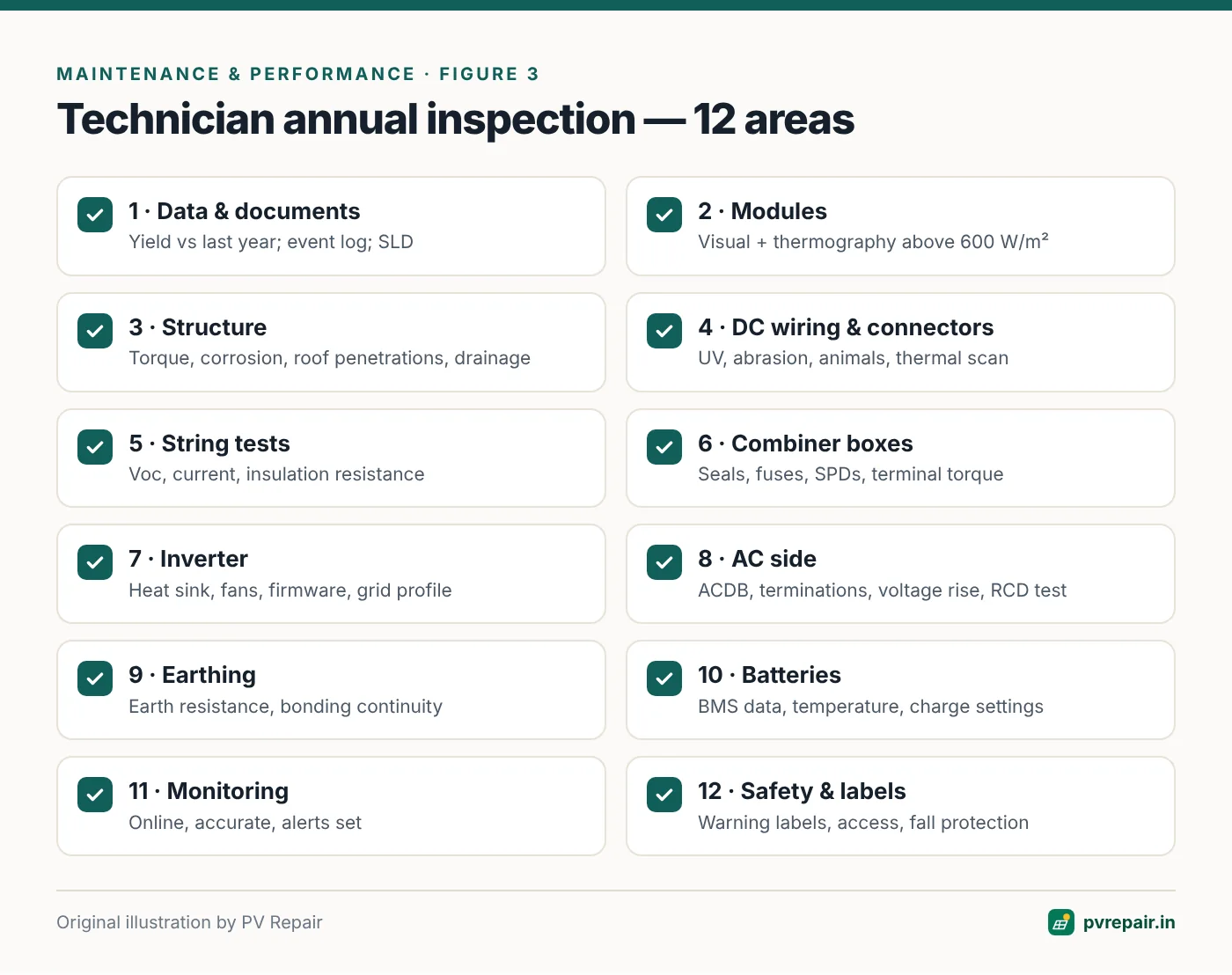
1. Documentation and data review
- Review the past year's generation against expectations and the previous year, adjusting for weather. See low generation diagnosis.
- Review the inverter event log for recurring faults. See reading fault codes.
- Check the single-line diagram and string layout are available and accurate.
2. Modules
- Visual inspection for broken glass, delamination, discolouration, burn marks, snail trails and backsheet damage where visible. See delamination and backsheet cracks and microcracks.
- Thermal imaging at good irradiance (above 600 W/m²) to find hotspots, warm junction boxes and substring patterns from failed bypass diodes.
- Check that modules are secure in their clamps, with no movement.
3. Mounting structure
- Check bolts and clamps for tightness (to specified torque) and corrosion, especially in coastal areas.
- Check roof penetrations and waterproofing around anchors.
- Look for structural deformation, especially after storms.
- Check that drainage isn't blocked by the structure or debris.
4. DC wiring and connectors
- Inspect all accessible cables for UV damage, abrasion, animal damage and proper support.
- Inspect connectors for discolouration, melting, cracks, and secure locking. Thermal-scan connectors under load. See MC4 connector failures.
- Check that no connectors are lying on the roof surface or in water paths.
5. String measurements
- Measure open-circuit voltage and operating current of each string, corrected for temperature, and compare strings. See string testing.
- Measure insulation resistance of each string (PV+ and PV− to earth) and compare with previous years.
- Record all results.
6. DC combiner boxes and isolators
- Check enclosure seals, glands and drain/breather plugs for water ingress.
- Check fuses and fuse holders; check SPD status indicators. See DC fuses and SPDs.
- Torque-check terminals (with the system isolated) and thermal-scan under load.
- Operate DC isolators to confirm they switch properly (with the system safely off-load).
7. Inverter
- Clean heat sinks, filters and vents; check fans. See overheating and derating.
- Check clearances and shading of the inverter.
- Check firmware version against the manufacturer's recommendation.
- Verify grid protection settings are the approved profile.
- Check AC and DC terminations for heat damage.
8. AC side
- Inspect the solar AC distribution box: MCBs/RCBOs, SPDs, terminals.
- Torque-check and thermal-scan AC terminations.
- Check AC voltage at the inverter under export and voltage rise to the meter. See grid overvoltage trips.
- Test the RCD (if fitted) with an RCD tester.
9. Earthing and lightning protection
- Measure earth electrode resistance and record it. See earthing and lightning protection mistakes.
- Check bonding continuity of frames and structures.
- Inspect earth conductors, clamps and lightning protection components for corrosion and damage.
10. Batteries (hybrid and off-grid)
- Check battery status, SOC, cell voltages and alarms via the BMS. See lithium BMS errors.
- For lead-acid: check electrolyte (flooded), terminal condition and battery room ventilation.
- Check battery temperature and location conditions.
- Verify charge settings. See battery not charging.
11. Monitoring
- Confirm monitoring is online and accurate; compare with the inverter's counter. See monitoring offline.
- Set up or verify alerts.
12. Safety and labelling
- Check that warning labels and isolation instructions are present and legible.
- Check that access routes are safe, and that walkways and fall protection are in place where needed.
Tools a technician should bring
A proper annual inspection needs more than a screwdriver and a multimeter. Expect a competent technician to arrive with:
- A CAT III 1000 V (or 1500 V) multimeter and DC clamp meter.
- An insulation resistance tester suitable for PV systems.
- An earth resistance tester.
- A thermal imaging camera with enough resolution to see individual cells and connectors.
- An irradiance meter or reference cell, and an infrared thermometer.
- Torque tools for terminals and structure bolts, and the specified torque values.
- Connector unlocking tools, spare matched connectors and the correct crimp tool.
- PPE: insulated gloves rated for the system voltage, eye protection, safety footwear and fall protection.
- An RCD tester for the AC side, and the inverter manufacturer's app or software for reading logs.
If a "maintenance visit" consists of a quick look and a cleaning, it isn't an inspection. Ask what tests will be done before you agree the scope.
The pre-monsoon focus list
If time or budget is limited, prioritise the items that prevent monsoon failures:
- Insulation resistance of every string, compared with last year.
- Connector condition and support — nothing lying in water paths.
- Combiner box and ACDB seals, glands and drain plugs.
- Earthing connections and SPD status.
- Roof drainage around the array and structure anchors.
- Cable protection against animals, which shelter under arrays during the rains.
Extra items for commercial rooftops
Larger systems justify a deeper scope:
- I–V curve tracing of every string or a representative sample, translated to STC, for a precise view of degradation and mismatch.
- Drone thermography of the whole array to find module-level defects quickly.
- Performance ratio analysis using on-site irradiance sensors, rather than rough benchmarks.
- Inverter-level comparison of specific yield to find underperforming inverters.
- Transformer and HT/LT panel maintenance where the plant connects at higher voltage, following the relevant electrical maintenance schedules.
- Anti-PID checks on high-voltage plants in hot, humid locations. See PID.
- Spare parts review — fuses, connectors, SPD cartridges and a spare inverter communication module on site.
What a good maintenance report contains
At the end of the visit, the technician should give you a written report including:
- Date, weather, irradiance during testing.
- String-by-string Voc, current and insulation resistance results.
- Earth resistance results.
- Thermal images of any anomalies, with photos.
- Defects found, actions taken, and recommendations with priority.
- Comparison with the previous year.
Keep these reports. They're invaluable for warranty claims, for selling the property, and for spotting slow trends like declining insulation resistance or growing PID.
Choosing a maintenance provider
Not every installer offers proper O&M, and not every O&M provider tests the same things. When comparing annual maintenance contracts, ask:
- What's the written scope? A list of tests (insulation, earth resistance, string measurements, thermography) is better than "general servicing".
- Will I get a report with measurements? Numbers you can compare year to year are the real value of a maintenance visit.
- How fast is the response to faults? Ask about response times for a dead inverter or a safety issue, and whether remote monitoring is included.
- Who handles warranty claims? A provider who documents faults properly and deals with manufacturers on your behalf saves you time.
- Are technicians trained and insured for work at height and on live DC systems?
Frequently Asked Questions
How often should solar panels be serviced?
A full inspection by a qualified technician once a year is a good baseline for residential systems, ideally before the monsoon. Commercial systems often have quarterly visits. Cleaning and monitoring checks happen more frequently.
What does solar maintenance cost?
It varies with system size, location and scope. Many installers offer annual maintenance contracts. Compare what's included — a visual check only, or full electrical testing and thermography.
Can I maintain my solar system myself?
Owners can safely monitor performance, clean panels (with care), and look for visible problems. Electrical testing, opening enclosures and working on wiring must be done by qualified technicians.
Why is pre-monsoon maintenance important?
Most moisture-related faults — isolation faults, residual current trips, corrosion — show up in the monsoon. Checking seals, connectors and insulation before the rains prevents many of them.
What records should I keep for my solar system?
Installation documents, single-line diagram, datasheets, warranty certificates, net metering papers, annual maintenance reports, monthly meter photos and any repair records.
Related guides
Solar System Producing Less Power Than Expected? A 10-Step Diagnosis
How much should your rooftop solar system really generate in India, and how to find out why it's producing less — from weather and soiling to shading, inverter clipping, string faults, degradation and monitoring errors.
Solar Monitoring Offline? Fixing Wi-Fi Dongle, Data Logger and App Problems
Why solar inverter monitoring goes offline — router changes, 2.4 GHz vs 5 GHz Wi-Fi, weak signal, power cuts, server and account issues — and a step-by-step method to reconnect Wi-Fi sticks, Ethernet loggers and 4G dongles.
Net Meter Problems with Rooftop Solar: Export Not Recording, Wrong Readings and Billing Issues
How bi-directional net meters work, how to read import and export registers, and how to troubleshoot export not recording, unexpectedly high bills, wrong CT polarity, and meter-related inverter faults with your DISCOM.