PV Overvoltage Error: When String Voltage Exceeds Your Inverter's Limit
Why PV overvoltage alarms appear on cold, bright mornings, how to calculate maximum string voltage with temperature correction, and how to fix an oversized string before it damages the inverter.
Of all the faults an inverter can report, PV Overvoltage, DC Overvoltage, PV Voltage High or Input Overvoltage is one of the few that can cause permanent damage. Most other alarms are the inverter protecting itself or the grid. With overvoltage, the inverter's input stage is being exposed to more voltage than its components are rated for — and protection can only do so much.
The fault is almost always a design error: too many modules connected in series for the coldest conditions on site. This guide shows why, how to do the calculation properly, and what to do if your system is affected.
Quick answer
Module voltage rises as temperature falls. A string that's comfortably below the inverter's maximum DC voltage on a warm afternoon can exceed it on a cold, clear morning. Calculate maximum Voc using the module's temperature coefficient and the lowest expected site temperature. If the result exceeds the inverter's maximum input voltage, remove modules from the string or re-configure — never ignore repeated overvoltage alarms.
Why voltage rises in the cold
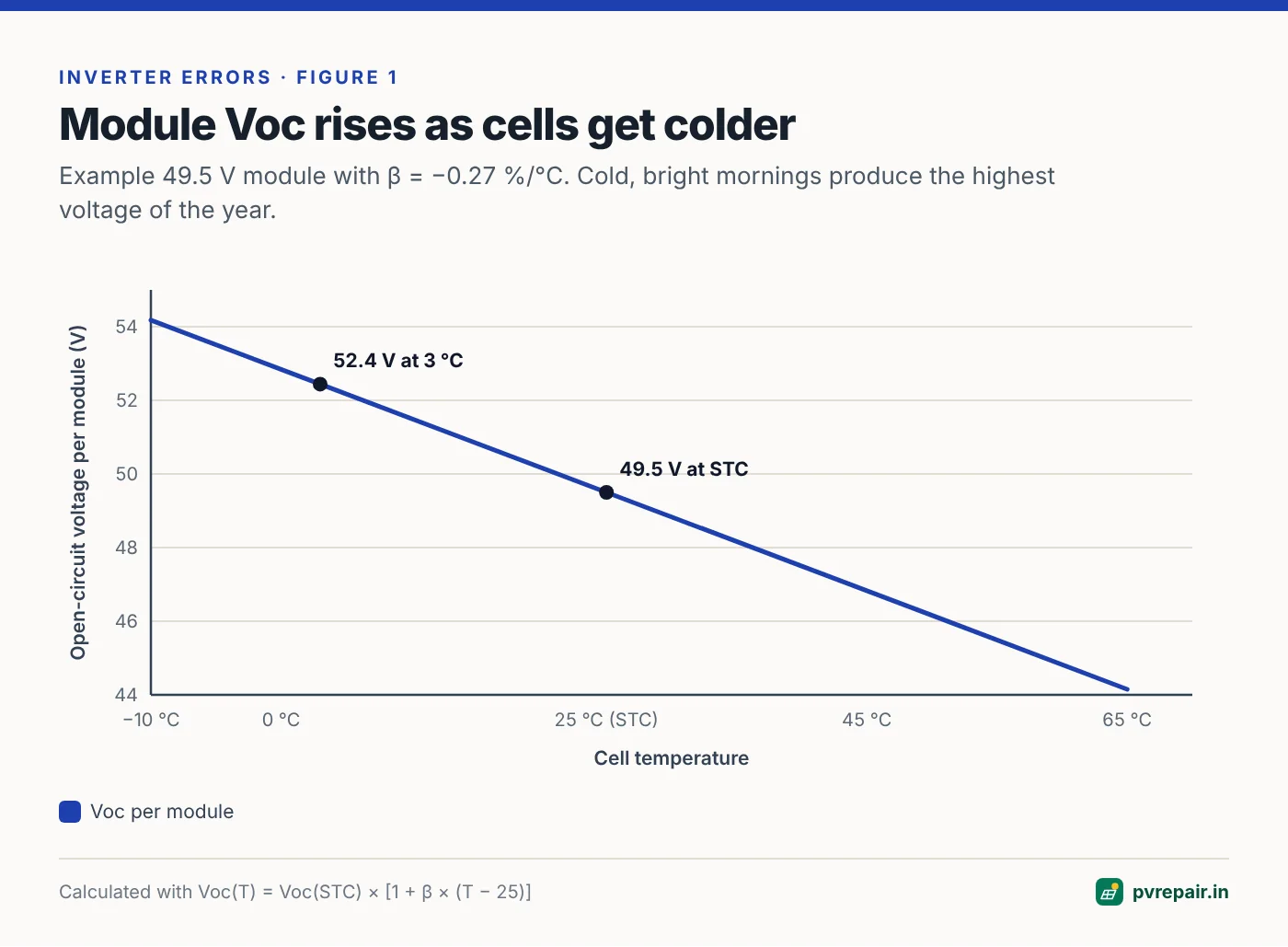
A solar cell's open-circuit voltage depends on temperature. As cells get colder, voltage increases. Every module datasheet gives a temperature coefficient of Voc (often written as β or TkVoc), typically between about −0.25 %/°C and −0.30 %/°C for modern crystalline modules.
The datasheet Voc is measured at Standard Test Conditions (STC): 25 °C cell temperature and 1000 W/m² irradiance. At dawn on a winter morning, cells can be close to ambient air temperature — or even below it, because a clear sky radiates heat away from panels overnight. If the sun then breaks through brightly while cells are still cold, Voc is at its highest.
Northern India regularly sees winter morning temperatures near 2–6 °C on the plains, and sub-zero temperatures in hill states and high-altitude regions. Even in milder regions, a string designed using only "typical" temperatures can be dangerously close to the limit.
Calculating maximum string voltage
The calculation is straightforward:
Voc(max) per module = Voc(STC) × [1 + β × (T(min) − 25)]
String Voc(max) = Voc(max) per module × number of modules in series
Where β is the temperature coefficient as a decimal (e.g., −0.0027 for −0.27 %/°C) and T(min) is the lowest expected cell temperature, usually taken as the record low ambient temperature for the site.
Worked example
A 545 Wp module has Voc(STC) = 49.5 V and β = −0.27 %/°C. Site minimum temperature is 3 °C. The inverter's maximum DC input voltage is 1000 V.
- Temperature difference: 3 − 25 = −22 °C
- Correction factor: 1 + (−0.0027 × −22) = 1 + 0.0594 = 1.0594
- Voc(max) per module: 49.5 × 1.0594 ≈ 52.4 V
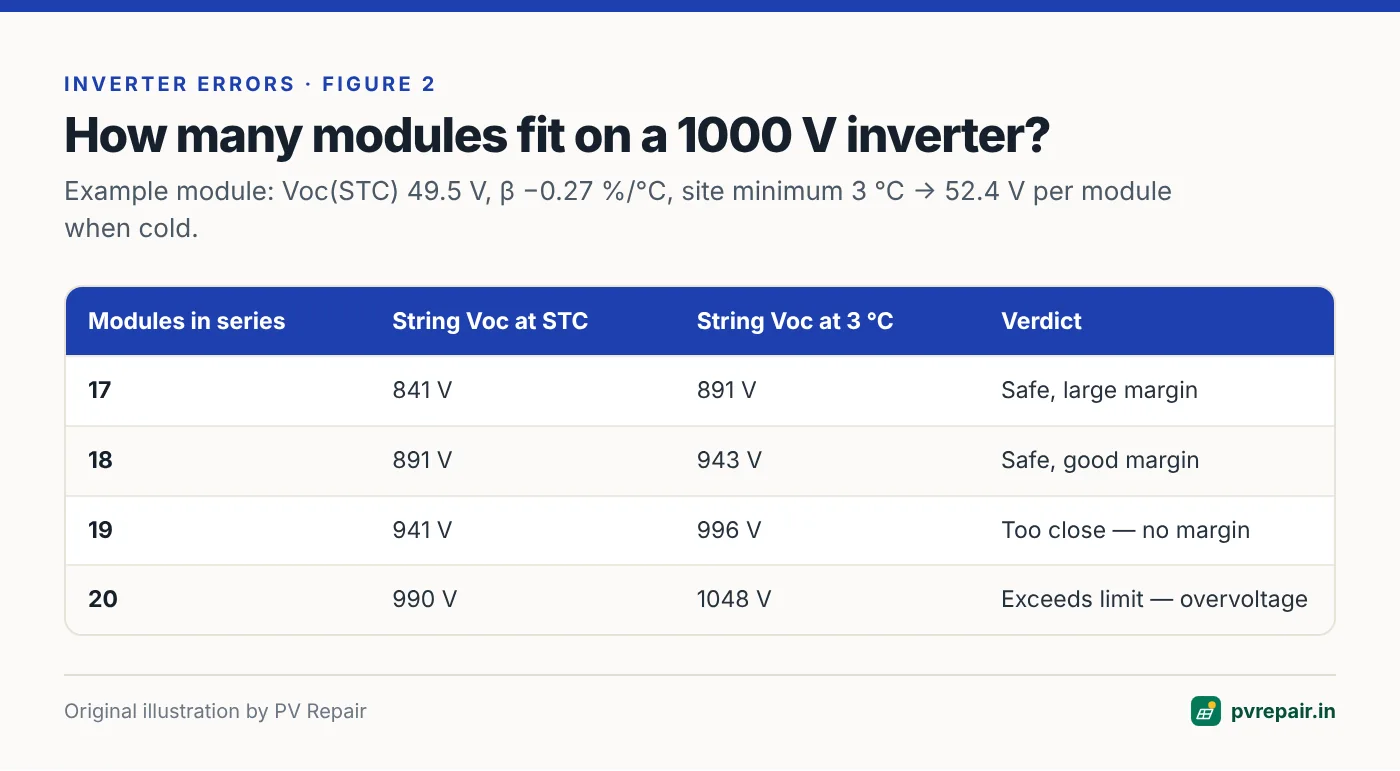
With 20 modules, the string reaches about 1048 V in the cold — above the 1000 V limit, even though at STC it's only 990 V. With 18 modules, it's about 943 V, leaving a sensible margin.
Don't design to STC Voc
The most common design mistake is checking that "20 × 49.5 V = 990 V, which is under 1000 V". That ignores temperature completely. Always use the cold-corrected value, and leave a margin.
Other factors to consider
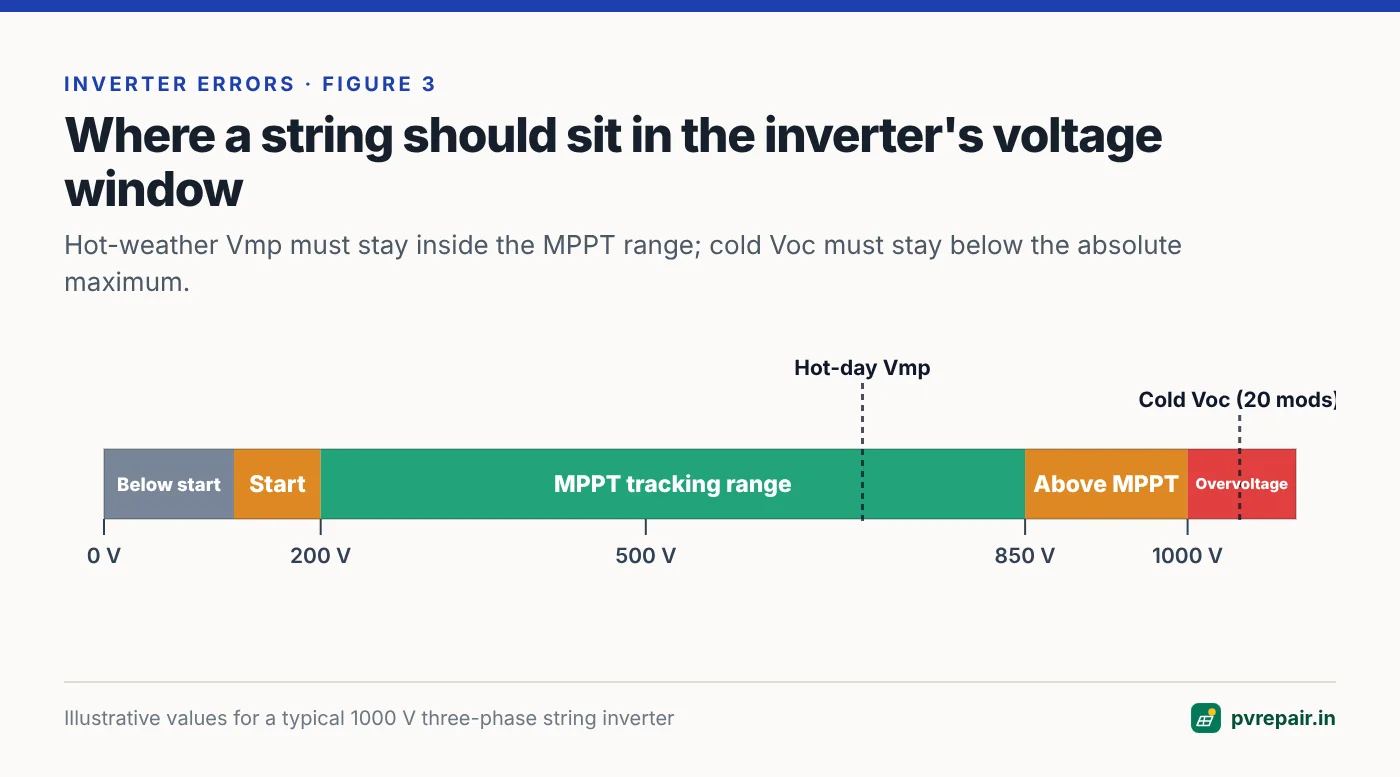
- The inverter's MPPT range and maximum DC voltage are different numbers. The MPPT range is where the inverter harvests efficiently; the maximum DC voltage is an absolute limit. Your cold Voc must stay below the absolute limit, and your hot Vmp should stay inside the MPPT range.
- Bifacial modules mainly add current rather than voltage, but always use the datasheet values.
- Module tolerance and degradation: new modules can measure slightly above datasheet Voc. A small design margin covers this.
- Optimisers and module-level electronics change the calculation — follow the manufacturer's design tool.
- Altitude and irradiance: high-altitude sites combine cold temperatures with strong irradiance, making them especially prone to overvoltage.
What happens when the limit is exceeded
The inverter monitors DC input voltage. If it exceeds a threshold, it refuses to start or disconnects and logs PV Overvoltage. That protects against modest overshoots. But the input stage — capacitors, semiconductors and surge protection — is still physically connected to the array while the DC isolator is closed. Sustained or large overvoltage can stress or damage those components. Many manufacturers explicitly exclude overvoltage damage from warranty, because it's an installation error.
Typical symptoms:
- Overvoltage alarms in the early morning on cold, clear days, clearing as the day warms up.
- Alarms that appear after modules were added to an existing string.
- An inverter failure in winter following a history of overvoltage events.
How to fix it
1. Confirm with measurements
On a cold, clear morning, measure the string Voc at the inverter input (with the DC isolator OFF) using a CAT III 1000 V or higher meter — or CAT III 1500 V for higher-voltage systems. Note module temperature with an infrared thermometer. Compare your measurement with the calculation.
2. Re-design the strings
The fix is to reduce the number of modules per string until cold Voc is safely within limits. Options include:
- Remove one or two modules from each string and re-use them to form an additional string, if the inverter has a spare MPPT input with a suitable voltage range.
- Re-configure strings across MPPT inputs — for example, changing from 2 × 20 modules to 3 × 14 or 4 × 10, as long as each string stays within the MPPT range on hot afternoons and current limits are respected.
- Change the inverter to one with a higher maximum DC voltage, if re-stringing isn't practical.
Design software makes these checks quick and repeatable. If you're an EPC, a tool that validates string sizing against site temperature data can prevent this fault entirely — see our overview of the best 3D solar design software for EPCs.
3. Inspect for damage
After a significant overvoltage history, check the inverter's DC surge protection devices (if replaceable) and any event codes indicating internal damage. Contact the manufacturer if internal faults appear.
The other end of the window: hot-weather voltage
Fixing overvoltage by simply shortening every string can create the opposite problem. On a hot April afternoon, rooftop cell temperatures in India commonly reach 60–70 °C. Module voltage falls as temperature rises, and if the string voltage at maximum power (Vmp) drops below the bottom of the inverter's MPPT range, the inverter can no longer track the maximum power point. Output drops sharply, often exactly when irradiance is highest.
Continuing the example: the module's Vmp at STC is 41.6 V. Using a Vmp temperature coefficient of roughly −0.35 %/°C (check your datasheet; many designers approximate with the Pmax coefficient), at a cell temperature of 70 °C:
Vmp(hot) ≈ 41.6 × [1 − 0.0035 × (70 − 25)] ≈ 41.6 × 0.8425 ≈ 35.0 V
An 18-module string gives about 631 V on a hot afternoon — comfortably inside a typical 200–850 V MPPT range. A 9-module string would give only about 315 V: still inside the range on paper, but at reduced efficiency for many inverters, and close to the minimum after a module or two is bypassed by a failed diode.
Good string sizing is therefore a balance. The cold Voc must stay below the absolute maximum with margin, and the hot Vmp must stay inside the MPPT range with margin. Most designs land in a fairly narrow band of acceptable module counts for each inverter and module combination.
Common real-world scenarios
Modules added after installation. An owner expands a system by adding two modules "to the end of the string" because there was roof space. The original design was already near the limit; the extension pushes cold Voc over. The fix is to form a new string, not to lengthen an existing one.
Module model changed during procurement. The design was done for one module, but a different model with a higher Voc was delivered. The installer kept the same string lengths. Always recheck string sizing when module models change.
Hill-station or high-altitude sites. Designers used plains temperatures for a site in a hill region. Winter nights well below freezing, followed by bright clear mornings, produce high voltages. Use local climate data for the specific location.
Mixed orientations on one MPPT. East and west strings on the same input see different temperatures and irradiance at sunrise. Usually not an overvoltage cause on its own, but it complicates measurement and diagnosis.
Tools for checking your strings
- A CAT III 1000 V or 1500 V rated multimeter, or a dedicated PV tester that records Voc, Isc and irradiance.
- An infrared thermometer or thermal camera to record module temperature at the time of measurement.
- The module datasheet (Voc, Vmp, temperature coefficients) and inverter datasheet (maximum DC voltage, MPPT range, start-up voltage).
- Local temperature records — the record low, not the average low.
Preventing PV overvoltage in new designs
- Use the record low ambient temperature for the site, not an average winter temperature.
- Apply the module's own temperature coefficient from the datasheet.
- Keep a margin below the inverter's maximum DC voltage (many designers aim for a few percent).
- Check hot-weather Vmp against the bottom of the MPPT range too, so the string doesn't drop out of tracking range in summer.
- Document string sizes on the single-line diagram so future technicians don't add modules to a string that's already at its limit.
Frequently Asked Questions
Why does my inverter only show PV overvoltage in winter mornings?
Module voltage is highest when cells are cold and the sun is bright. Winter mornings provide exactly those conditions, so a string that's slightly too long will only exceed the limit then.
Will PV overvoltage damage my inverter?
It can. The inverter stops operating to protect itself, but the input components remain connected to the array. Repeated or large overvoltages can cause permanent damage that warranties often exclude.
Can I just switch off the inverter on cold mornings?
Switching off the AC side doesn't remove DC voltage from the inverter input. Only the DC isolator does — and that's not a sensible daily routine. The right fix is to correct the string design.
How many panels can I put in series on my inverter?
Divide the inverter's maximum DC input voltage by the cold-corrected Voc of one module, then round down and keep a margin. Also check that the hot-weather Vmp of the string stays within the MPPT range.
Do higher-wattage panels make overvoltage more likely?
Not necessarily — it depends on each module's Voc, not its wattage. Large-format modules often have higher Voc per module, so fewer fit in a string. Always recalculate when changing module models.
Related guides
How to Read Solar Inverter Fault Codes: A Universal Guide for Any Brand
Inverter error codes look cryptic, but almost every brand groups them into the same handful of categories. Learn to decode any fault code, use the event log, and decide what you can check yourself.
Solar Inverter Not Turning On? A Systematic Diagnosis From Panels to Display
Blank screen, no LEDs or stuck on "Waiting"? Work through the DC supply, start-up voltage, isolators, fuses and internal faults in the right order to find why your solar inverter won't start.
Residual Current (RCD / GFCI) Fault on Grid-Tie Inverters Explained
What a residual current, leakage current or GFCI fault on a solar inverter means, how it differs from an isolation fault, and how to find wet cables, damaged insulation and nuisance-tripping RCDs.