Residual Current (RCD / GFCI) Fault on Grid-Tie Inverters Explained
What a residual current, leakage current or GFCI fault on a solar inverter means, how it differs from an isolation fault, and how to find wet cables, damaged insulation and nuisance-tripping RCDs.
Your inverter runs normally in the morning, then trips with Residual Current High, Leakage Current Fault, GFCI Fault, RCD Fault or Ground Current Abnormal — often during or just after rain. Or perhaps the RCCB in your solar distribution board keeps tripping. These are residual current problems, and while they're related to the isolation faults covered in our Riso guide, they are detected differently and have a few unique causes.
This guide explains what residual current monitoring is, why transformerless inverters need it, what causes trips, and how to diagnose them safely.
Quick answer
Residual current is the imbalance between current flowing out and current flowing back in. If some current leaks to earth through damaged insulation or moisture, the imbalance rises and the inverter's residual current monitoring unit (RCMU) disconnects it. Causes include wet or damaged DC cables and connectors, cracked module backsheets, water in junction boxes, and incorrectly specified external RCDs. Diagnosis follows the same principles as an isolation fault, but focuses on faults that develop while the system is running.
Isolation fault vs residual current fault
The two are easy to confuse because both relate to leakage to earth. The key difference is when they're detected:
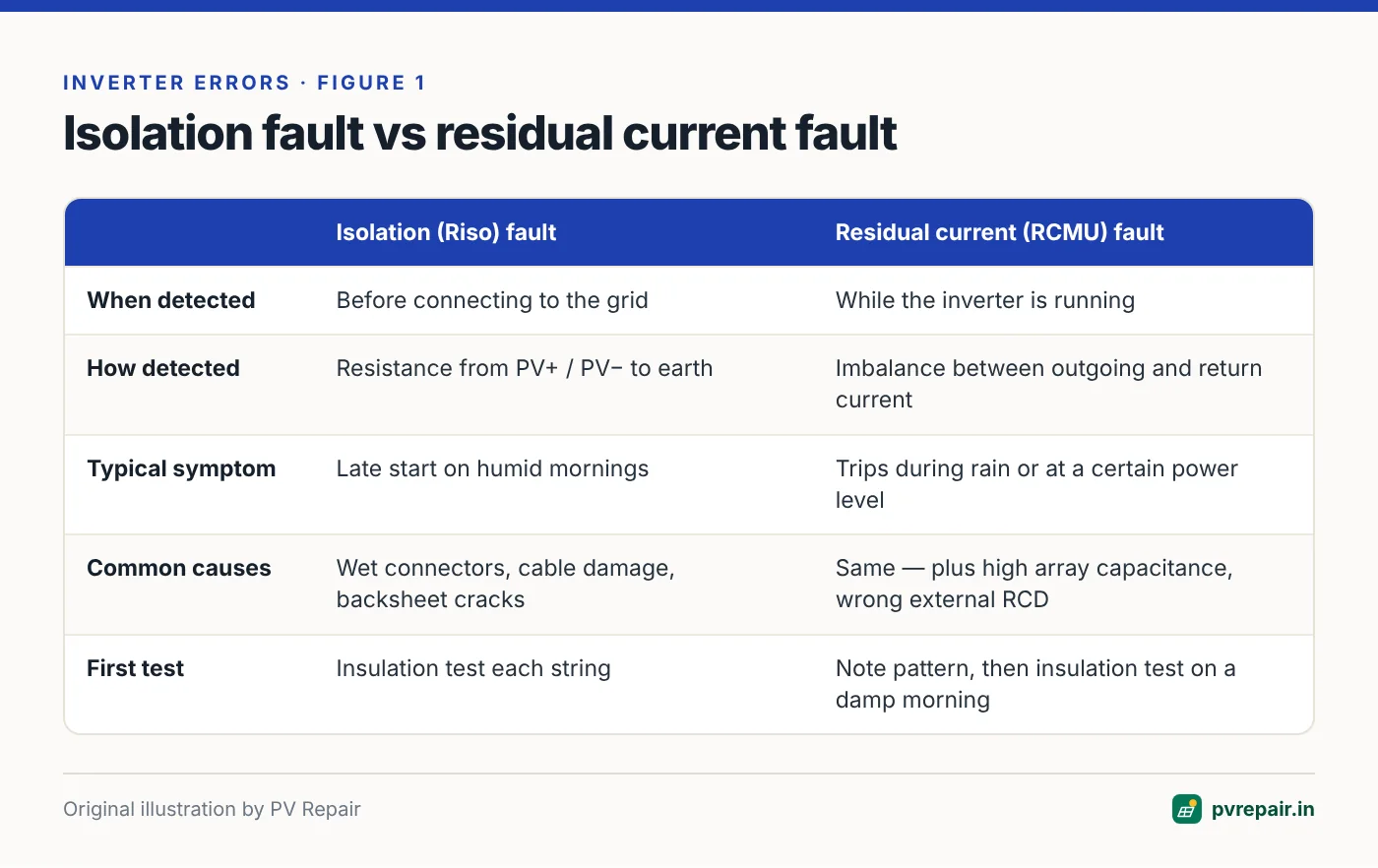
An isolation fault is detected by a resistance measurement before the inverter connects to the grid. A residual current fault is detected while the inverter is running, by measuring the actual leakage current. In practice, a damaged cable may cause both: the inverter starts on a dry morning, passes its Riso test, and then trips on residual current when rain starts in the afternoon.
Why transformerless inverters monitor residual current
Most rooftop inverters sold today are transformerless. Without a galvanic transformer between the PV array and the grid, the PV conductors are electrically referenced to the grid's neutral and earth. That means a person touching a damaged PV cable while standing on an earthed roof could complete a circuit. Leakage through damaged insulation can also cause fires.
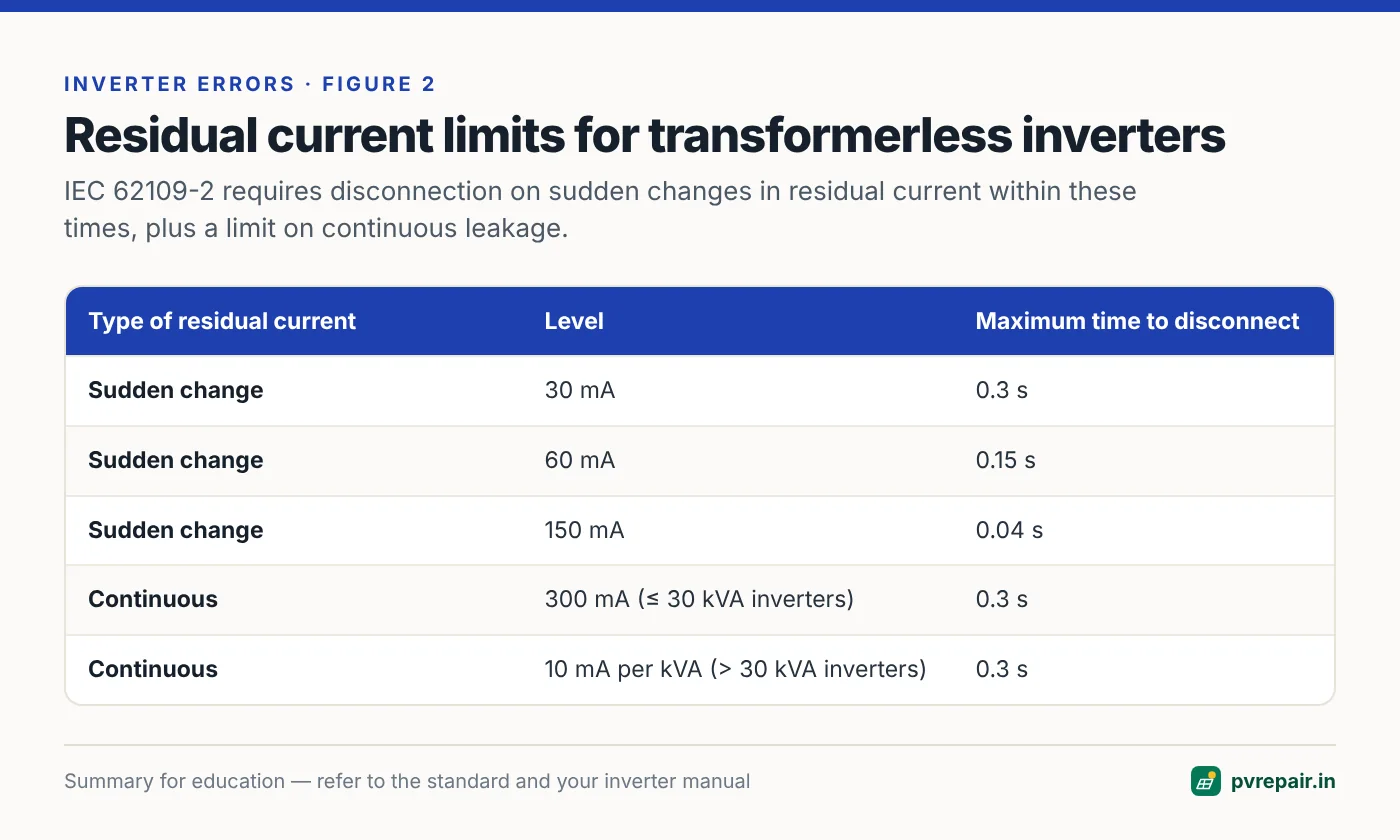
To manage this, inverter safety standard IEC 62109-2 requires transformerless inverters to include residual current monitoring that reacts both to a slow build-up of continuous leakage and to sudden jumps that could indicate a person receiving a shock.
Normal leakage vs fault leakage
Some leakage is normal and unavoidable. A PV array is a large flat conductor sitting a few millimetres from an earthed frame, separated by glass, encapsulant and backsheet. It forms a capacitor to earth. As the inverter switches, a small capacitive current flows through this capacitance continuously. On large arrays, metal roofs or with certain module types, this current is higher. Wet modules increase it further, because water on the glass effectively enlarges the capacitor plates.
A residual current fault happens when the total — normal capacitive leakage plus any resistive fault leakage — exceeds the inverter's limits, or when there's a sudden jump.
Common causes
Moisture in the DC system
As with isolation faults, water is the number one cause. Poorly crimped or mismatched MC4 connectors, wet combiner boxes, and cable damage all allow water to create a leakage path. Residual current trips that cluster during and after rain, or with early-morning dew, point here.
Damaged module backsheets and junction boxes
Backsheet cracking — especially in some older polyamide-based backsheets — exposes the internal circuit to moisture. This often shows up first as residual current trips in wet weather. Inspect the rear of modules for cracks, chalking and yellowing. See delamination, backsheet cracks and broken glass.
Cable damage from rodents, monkeys and abrasion
In India, rodents, squirrels and monkeys cause a large share of cable insulation failures. Abrasion against sharp module frames or rails, and pinching under clamps, are installation causes. Our rodent and bird damage guide covers protection methods.
High array capacitance
Large arrays on metal roofs, frameless or glass-glass modules, and very wet conditions can raise normal capacitive leakage close to the trip limit. Here there's no "fault" to find; the solution may involve the inverter manufacturer's guidance, splitting the array across more inverters, or firmware updates.
Wrong external RCD
An RCD (RCCB/RCBO) in the inverter's AC circuit is a separate device from the inverter's internal RCMU. If an external RCD is fitted with too low a rating or the wrong type, it may trip on the inverter's normal leakage. Many manufacturers state that their transformerless inverters, with built-in RCMU, can be used with a Type A RCD, and recommend a minimum rated residual current (often 30 mA for small inverters and higher, such as 100 mA or 300 mA, for larger ones). Always follow the inverter manual and local wiring rules.
Two different devices
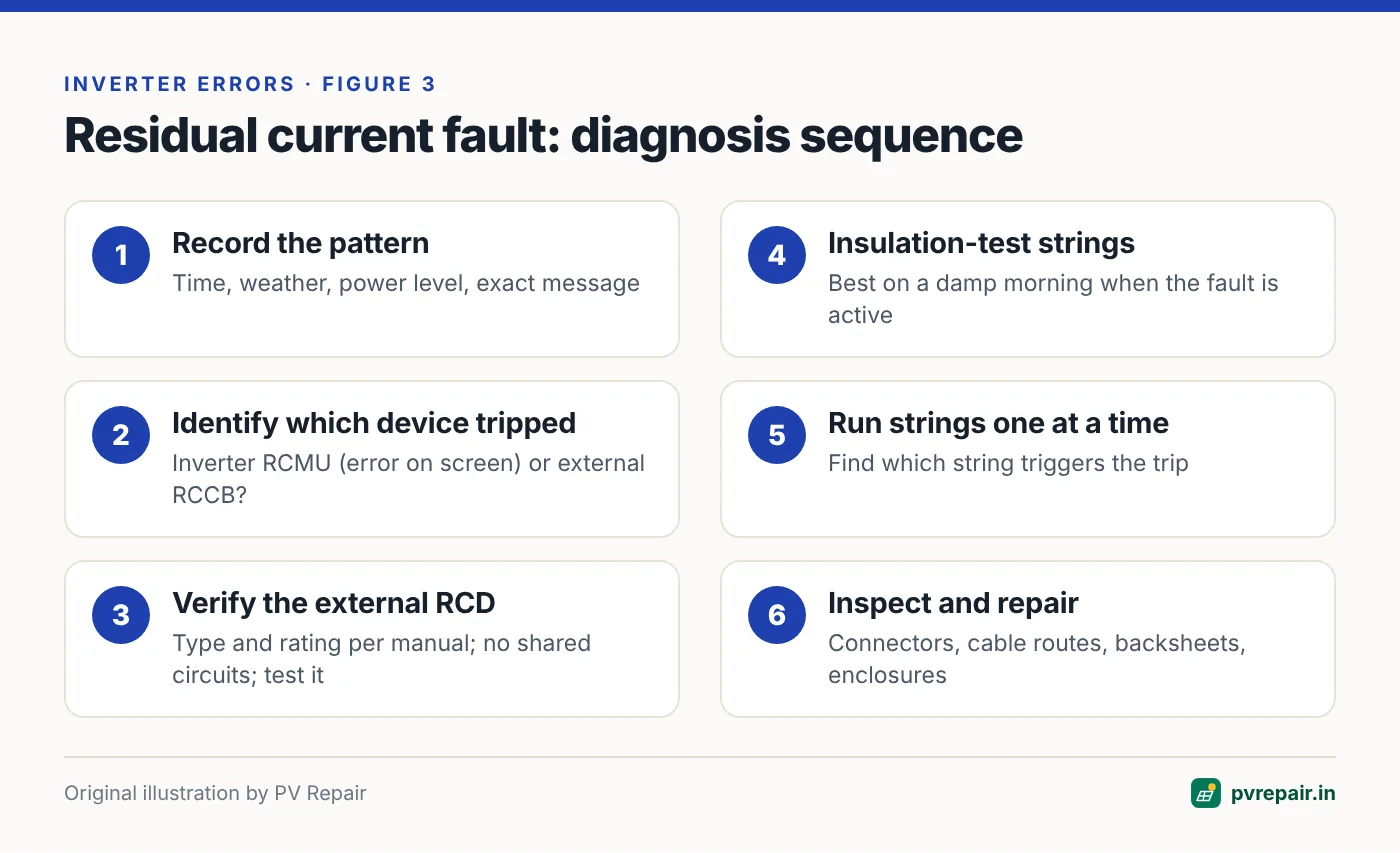
Inverter trips with a residual current error on its display → the inverter's internal RCMU detected leakage. RCCB in the distribution board trips, inverter shows No Grid → the external RCD tripped. The diagnosis paths differ, so note which one is happening.
Step-by-step diagnosis
1. Record the pattern
Note the time, the weather, and the exact message. Does it happen at a particular power level? Only after rain? Only in the morning dew? A strong weather correlation suggests moisture. A trip at the same power level every day suggests a fault that worsens with voltage or current.
2. Check the external RCD (if that's what's tripping)
Confirm the RCD type and rating match the inverter manual. Check that no other circuits share the RCD — a leakage from household loads on the same RCD adds to the inverter's leakage. Test the RCD with an RCD tester to confirm it trips within specification and not prematurely.
3. Insulation-test the DC strings
With the system safely isolated, test each string's insulation resistance to earth as described in our isolation fault guide. Testing on a damp morning, when the fault is active, gives the most useful results. Any string reading notably lower than the others is your prime suspect, even if it's above 1 MΩ.
4. Run on fewer strings
If insulation tests don't reveal a clear culprit, connect strings to the inverter one at a time (or one MPPT at a time) over several days. If the trips only happen when a particular string is connected, focus on it.
5. Inspect physically
Walk the faulty string. Look under modules for hanging connectors, check cable routing over sharp edges, open combiner boxes for water, and inspect backsheets near junction boxes.
6. Check AC-side wiring
Rarely, an AC-side issue — a neutral-earth fault in the building, or a borrowed neutral between circuits — can upset the inverter's measurement. Have a licensed electrician check the inverter AC circuit for proper separation of neutral and earth.
Repairs
- Replace damaged cables and connectors with matched, correctly crimped components.
- Replace modules with cracked backsheets or failed junction boxes.
- Dry out, re-seal or replace leaking enclosures, and add drain/breather fittings.
- Correct the external RCD type and rating if it doesn't match the manual.
- For high-capacitance arrays, consult the inverter manufacturer.
After repairs, insulation-test again and record the results as a baseline for future comparison.
Preventing residual current faults
Most residual current problems are designed in or installed in. A few habits at installation and maintenance time prevent the majority of them:
- Keep the DC side dry by design. Mount combiner boxes with cable entries at the bottom, fit drain or breather plugs, and use glands sized for the cable. Never leave connectors lying flat on a roof surface where water pools.
- One connector brand, one crimp tool. Cross-mating different brands of "MC4-compatible" connectors is a well-known source of water ingress, and it voids most connector certifications.
- Protect cable runs. Use UV-rated conduit or covered trays between rows, edge protection where cables pass over metal, and rodent-proof routing wherever cables are reachable.
- Size inverters with leakage in mind. On very large single arrays — especially on metal roofs — splitting the array across more inverters keeps each inverter's normal capacitive leakage well below its limit.
- Separate circuits. Give the inverter its own dedicated AC circuit and protective device so household appliance leakage doesn't stack up on the same RCD.
- Trend your insulation readings. Record each string's insulation resistance at commissioning and at every annual service. A string whose readings fall year after year is telling you about a developing fault long before it trips the inverter.
What to tell your installer
If you're a homeowner, a short, factual report speeds diagnosis enormously: the exact error text or code, a photo of the inverter screen, the dates and times of trips, and whether it rained. If the external RCCB trips, say so specifically — it tells the technician to check the AC side and RCD selection first rather than climbing onto the roof.
Frequently Asked Questions
Is a residual current fault dangerous?
It can be. It means current is flowing to earth where it shouldn't, which can create a shock or fire hazard. The inverter disconnects to protect you, but the underlying fault should be found and fixed promptly.
Why does my inverter only trip with a residual current fault when it rains?
Rain wets the modules and any damaged insulation, increasing both normal capacitive leakage and fault leakage. A weak point that doesn't conduct when dry may conduct when wet.
Can I bypass or remove the RCD to stop the trips?
No. Removing or bypassing protective devices is dangerous and may breach electrical regulations and your installation approval. Fix the cause or, if the RCD is the wrong type or rating, replace it with what the inverter manual specifies.
What type of RCD should I use with a solar inverter?
Follow the inverter manufacturer's instructions. Many transformerless inverters with internal RCMU specify a Type A RCD with a minimum rating that depends on inverter size. Using too sensitive a rating can cause nuisance trips.
Can a faulty inverter cause residual current errors?
It's possible but uncommon. If every string tests healthy, the external wiring is sound and the error persists with only one known-good string connected, contact the manufacturer.
Related guides
PV Overvoltage Error: When String Voltage Exceeds Your Inverter's Limit
Why PV overvoltage alarms appear on cold, bright mornings, how to calculate maximum string voltage with temperature correction, and how to fix an oversized string before it damages the inverter.
How to Read Solar Inverter Fault Codes: A Universal Guide for Any Brand
Inverter error codes look cryptic, but almost every brand groups them into the same handful of categories. Learn to decode any fault code, use the event log, and decide what you can check yourself.
Solar Inverter Not Turning On? A Systematic Diagnosis From Panels to Display
Blank screen, no LEDs or stuck on "Waiting"? Work through the DC supply, start-up voltage, isolators, fuses and internal faults in the right order to find why your solar inverter won't start.