Solar Panel Cleaning Guide: Methods, Frequency, Water Quality and Mistakes to Avoid
How often to clean solar panels in Indian conditions, which methods are safe, why water quality matters, how to avoid thermal shock and scratching, and how to clean without voiding your module warranty.
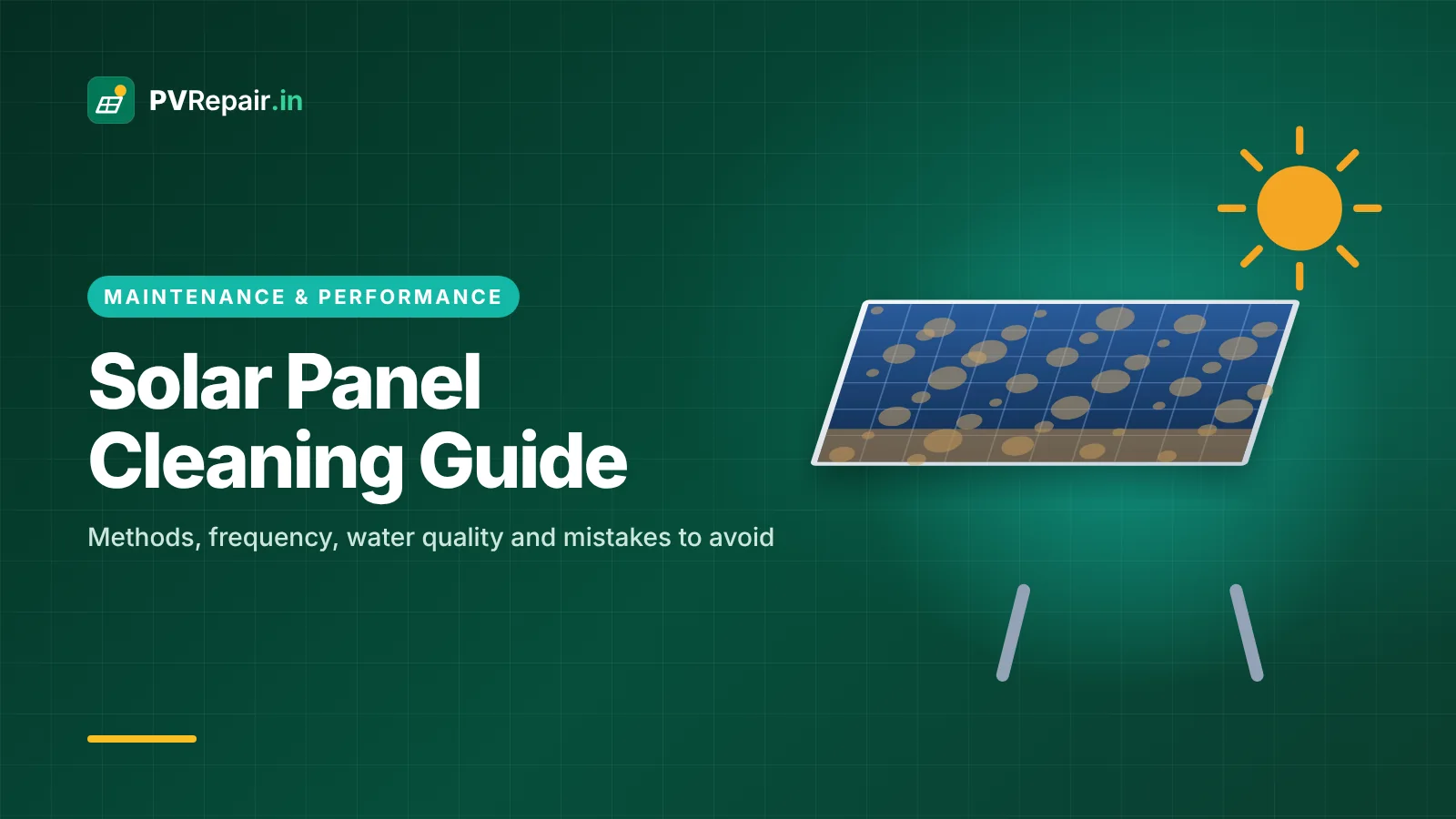
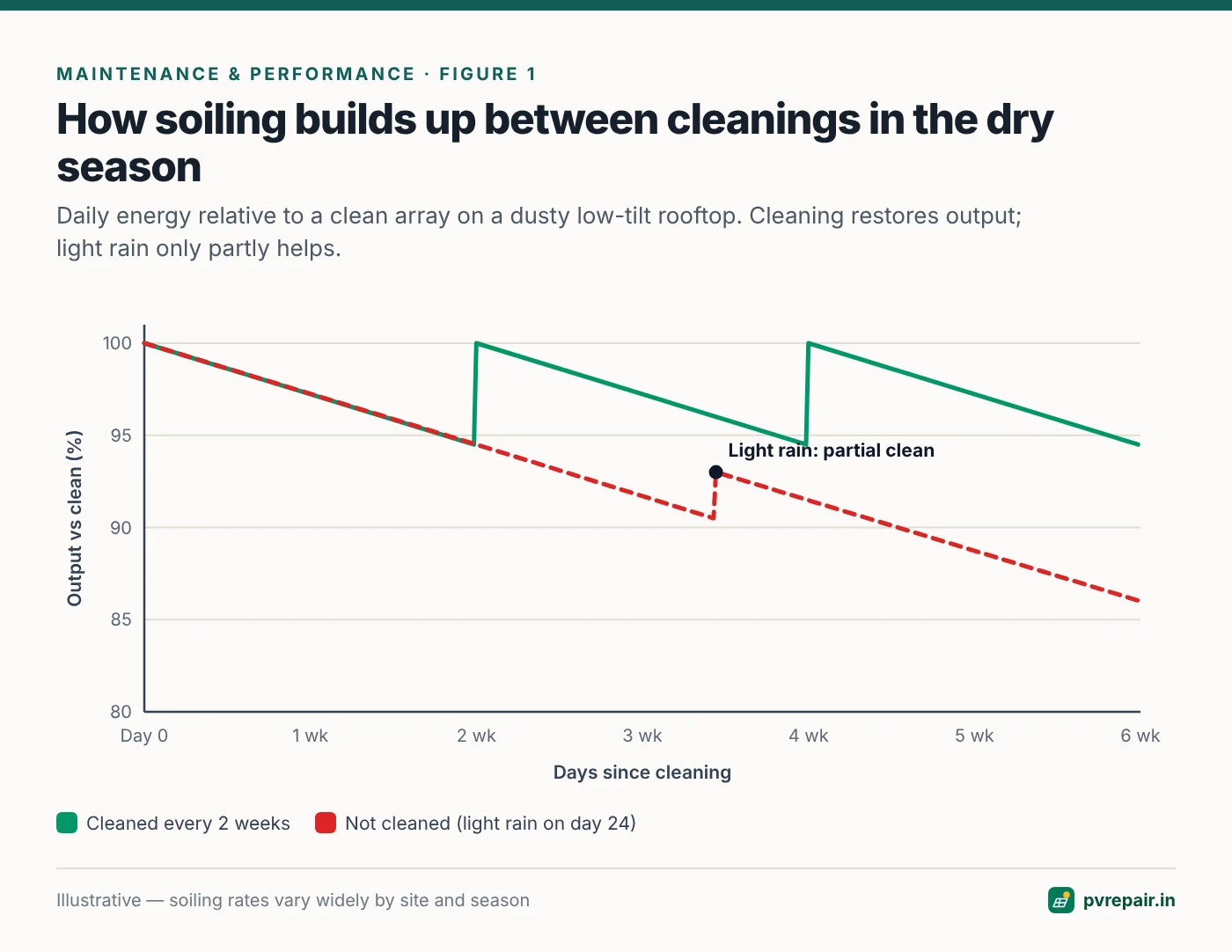
Dust is one of the biggest controllable losses for solar systems in India. Long dry seasons, construction dust, desert dust in the west and north-west, industrial pollution, pollen, and bird droppings all collect on modules. On a low-tilt rooftop that hasn't been rained on for weeks, soiling can easily reduce output by 5–15%, and much more in very dusty locations or after a dust storm.
Cleaning is simple in principle, but done wrong it can scratch the glass, damage the anti-reflective coating, crack cells, create electrical hazards and void the module warranty. This guide covers how often to clean, which methods and water to use, and the common mistakes to avoid.
Quick answer
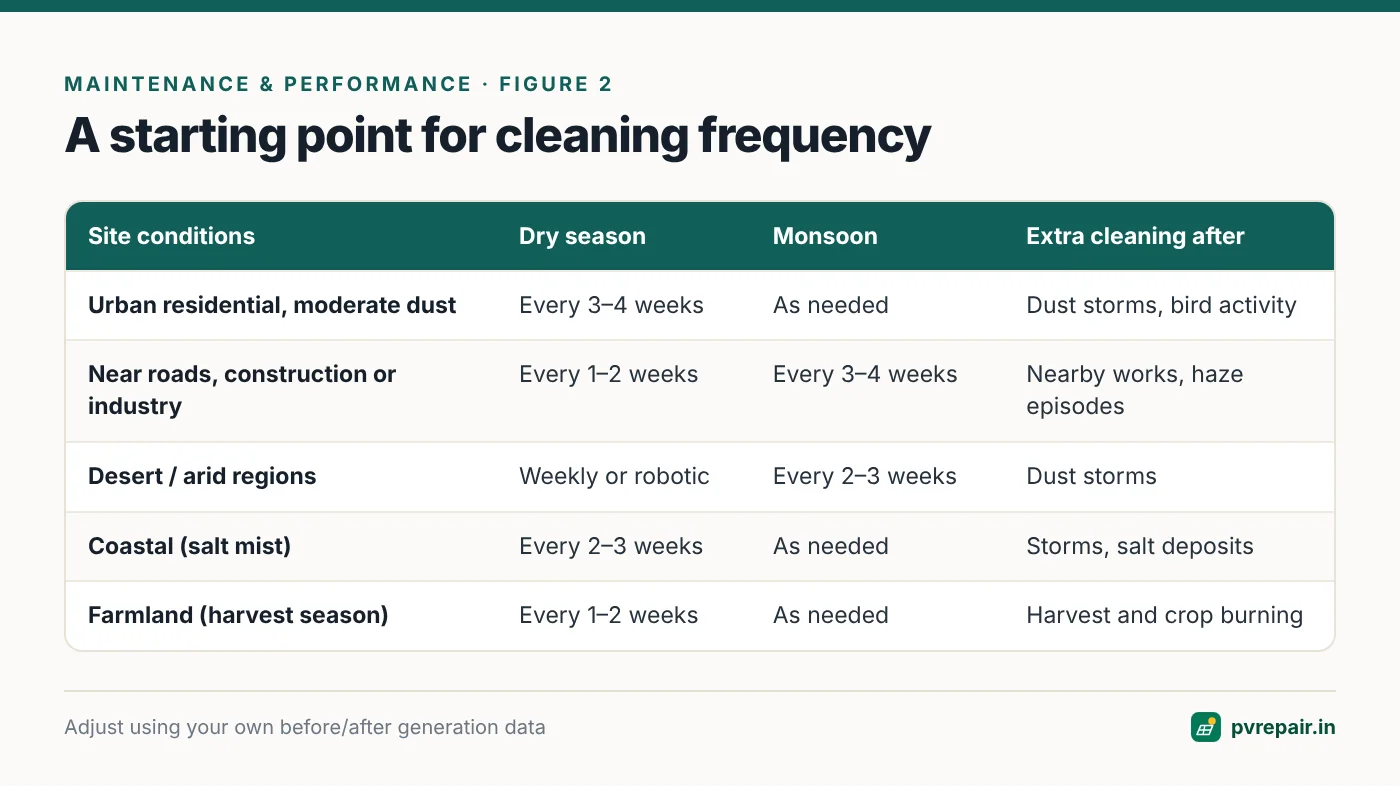
Clean when soiling is visibly reducing output — typically every 2–4 weeks in dry, dusty months in much of India, less often in the monsoon. Use low-mineral (soft) water, a soft brush or sponge on a long handle, and clean in the early morning or evening when modules are cool. Never stand on modules, never use abrasive tools or harsh chemicals, avoid high-pressure jets, and follow the module manufacturer's cleaning instructions.
How much does soiling cost you?
Soiling losses vary hugely with location, season, tilt and nearby dust sources:
- Low-tilt rooftops (10–15°) collect more dust and self-clean less in rain than steeper modules.
- Dust ridges along the bottom edge form where rainwater runs down and evaporates, leaving dirt against the frame. These are particularly harmful because they shade the bottom row of cells and can cause hotspots.
- Bird droppings block light completely over a small area and are a leading cause of localised hotspots.
- Nearby construction, roads, cement plants, brick kilns and farms (especially during harvest and stubble burning) dramatically increase dust deposition.
- Monsoon rain cleans modules naturally, but light rain on dusty modules can leave muddy streaks rather than cleaning them.
A simple way to measure your own soiling loss: compare generation on two similar clear days, one just before cleaning and one just after.
How often to clean
There's no single right answer. A practical approach:
- Watch the data. If generation on clear days drops steadily between cleanings, you're losing energy to soiling.
- Clean when the value of lost energy exceeds the cost of cleaning. For homes doing their own cleaning safely, that might simply be every few weeks in the dry season. For commercial plants paying for cleaning crews, the frequency is an economic decision.
- Always clean after dust storms, nearby construction, or bird activity.
Safety first
Rooftops and electricity
Falls from roofs are a serious risk — use edge protection or fall arrest, and never clean on wet, slippery or steep roofs without proper equipment. Modules generate voltage in daylight; damaged modules, cables or connectors can make water conductive paths to live parts. Inspect for damage before cleaning, and never spray water on damaged modules, junction boxes, connectors or inverters.
- Don't walk or stand on modules. It can cause microcracks even if the glass doesn't break.
- Keep water away from inverters, combiner boxes and connectors.
- If a module is broken or a cable is damaged, don't clean it — isolate and repair first. See delamination, backsheet cracks and broken glass.
Water quality matters
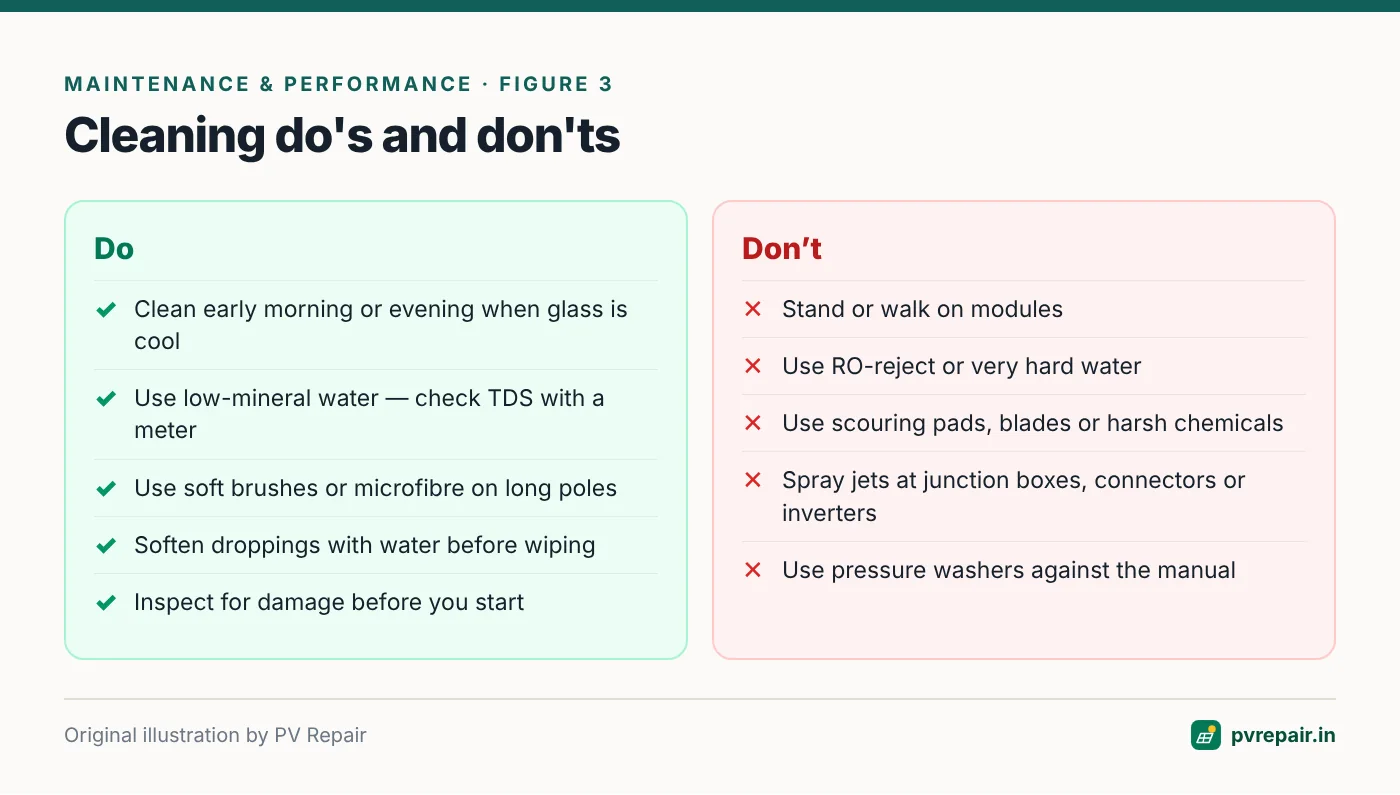
Hard water — high in dissolved minerals — leaves white spots and a film on the glass when it evaporates, which can build up over time and reduce light transmission. Many module manufacturers recommend using low-mineral water. Recommended limits vary; values of total dissolved solids (TDS) in the low hundreds of ppm or less are commonly cited, and some O&M specifications use much lower values. Check your module's cleaning instructions.
Practical options:
- RO-reject water is generally not suitable because it's concentrated in minerals.
- Rainwater collected in clean tanks is often low in minerals.
- RO or demineralised water for final rinsing on sites with very hard groundwater.
- Measure TDS with an inexpensive TDS meter to know what you're using.
Many parts of India have hard groundwater, so this is worth checking before you set up a cleaning routine.
Recommended cleaning method
- Clean when modules are cool — early morning or late evening. Splashing cold water onto glass at 60–70 °C causes thermal shock, which can stress the glass, and water evaporates too quickly on hot glass, leaving spots.
- Remove loose dust first with a dry soft brush or gentle rinse.
- Wet the surface with low-pressure water.
- Gently wipe with a soft brush, soft sponge or microfibre on a long, extendable pole from the edge of the array or a walkway. Work from top to bottom.
- Soften bird droppings with water before wiping; don't scrape.
- Rinse with clean, low-mineral water.
- Let it dry naturally or squeegee gently with a soft rubber squeegee.
Cleaning agents
Plain water is enough most of the time. If manufacturers permit it, a small amount of mild, non-abrasive, pH-neutral detergent can help with greasy films or bird droppings — rinse thoroughly. Avoid:
- Acidic or alkaline cleaners, solvents, ammonia and bleach.
- Abrasive powders or creams.
- Anything that leaves a residue.
Pressure washers
High-pressure jets can damage seals, frame joints and the anti-reflective coating, and force water into junction boxes. Many manufacturers either prohibit pressure washers or set a maximum pressure. If used at all, use low pressure, a wide spray pattern, and keep a good distance — and only if the module manual allows it.
A simple, safe cleaning kit
For a home or small commercial rooftop, you don't need specialised equipment:
- An extendable pole (aluminium or fibreglass) long enough to reach the far edge of the array from a walkway or the array edge.
- A soft-bristle brush head designed for glass or solar panels, and a microfibre or soft sponge head.
- A soft rubber squeegee head for drying, if your water leaves spots.
- A hose with a gentle spray nozzle or a bucket system — no high-pressure jets.
- A TDS meter to check water quality.
- Non-slip footwear, gloves, and fall protection appropriate to the roof.
Keep the kit dedicated to the solar array, so brushes don't pick up grit from cleaning floors or vehicles — grit trapped in bristles is a common cause of fine scratches.
Measuring the benefit of cleaning
A quick experiment tells you whether your cleaning schedule is right. On a clear day, note the generation in your monitoring app. Clean the array that evening. Note generation on the next clear day with similar weather. The difference is your soiling loss for that interval.
Repeat the measurement at different points in the season. If you see 1–2% after three weeks, you might be cleaning more often than you need. If you see 8–10% after two weeks, clean more often — or investigate a local dust source. For commercial plants, some operators install a pair of reference modules or a soiling sensor, keeping one clean and one uncleaned, to track soiling losses continuously and schedule cleaning on data rather than the calendar.
Mistakes to avoid
- Standing or walking on modules.
- Using abrasive brushes, scouring pads, steel wool or hard bristles.
- Scraping off droppings with knives or blades.
- Cleaning in the heat of the day.
- Using hard or RO-reject water.
- Spraying water directly at junction boxes, connectors or inverters.
- Using harsh chemicals or detergents not approved by the manufacturer.
- Leaving loose hoses and buckets where they could fall or damage modules.
Automated and robotic cleaning
For large commercial and utility plants, robotic dry-cleaning systems (brushes that travel along module rows, often at night) and semi-automatic water-based systems are increasingly common, especially in water-scarce dusty regions. They reduce water use and labour, but must be approved by the module manufacturer and maintained properly — worn brushes can scratch glass.
Anti-soiling coatings
Some modules come with anti-soiling or hydrophobic coatings, and aftermarket coatings exist. Results vary, and some coatings can affect the module's anti-reflective layer or warranty. Ask the module manufacturer before applying anything to the glass.
Make cleaning part of maintenance
Cleaning visits are a good opportunity for a quick visual inspection: cracked glass, discoloured junction boxes, hanging connectors, nests and new shading. Record what you see. See our annual maintenance checklist for a full routine.
Frequently Asked Questions
How often should I clean my solar panels in India?
In dusty, dry months, every 2–4 weeks is common for rooftop systems, and less often during the monsoon. The best guide is your own generation data: clean when soiling is visibly reducing output.
Can I use tap water to clean solar panels?
If your tap water is hard (high in dissolved minerals), it can leave spots and residue. Check TDS with a meter and use low-mineral water or rainwater where possible, especially for the final rinse.
Is it okay to clean solar panels at noon?
It's better to avoid it. Hot glass and cold water can cause thermal stress, water evaporates quickly leaving spots, and it's harder and more dangerous to work in midday heat. Clean in the early morning or evening.
Will cleaning void my solar panel warranty?
Cleaning with approved methods won't. Using abrasive tools, harsh chemicals, high-pressure washers against instructions, or walking on modules can damage them and may void the warranty. Follow the manufacturer's cleaning guidance.
Do I need to switch off the system to clean the panels?
For routine cleaning of intact modules with water and a soft brush, many manufacturers don't require switching off. But if there's any damage to modules, cables or connectors, isolate the system and get it repaired before cleaning. Always follow your installer's and the manufacturer's instructions.
Related guides
Annual Solar PV Maintenance Checklist for Homes and Commercial Rooftops
A complete, practical annual maintenance checklist for rooftop solar in India — visual inspection, modules, structure, DC and AC wiring, inverters, earthing, batteries, monitoring and documentation — with what owners can do and what needs a technician.
Solar System Producing Less Power Than Expected? A 10-Step Diagnosis
How much should your rooftop solar system really generate in India, and how to find out why it's producing less — from weather and soiling to shading, inverter clipping, string faults, degradation and monitoring errors.
Solar Monitoring Offline? Fixing Wi-Fi Dongle, Data Logger and App Problems
Why solar inverter monitoring goes offline — router changes, 2.4 GHz vs 5 GHz Wi-Fi, weak signal, power cuts, server and account issues — and a step-by-step method to reconnect Wi-Fi sticks, Ethernet loggers and 4G dongles.